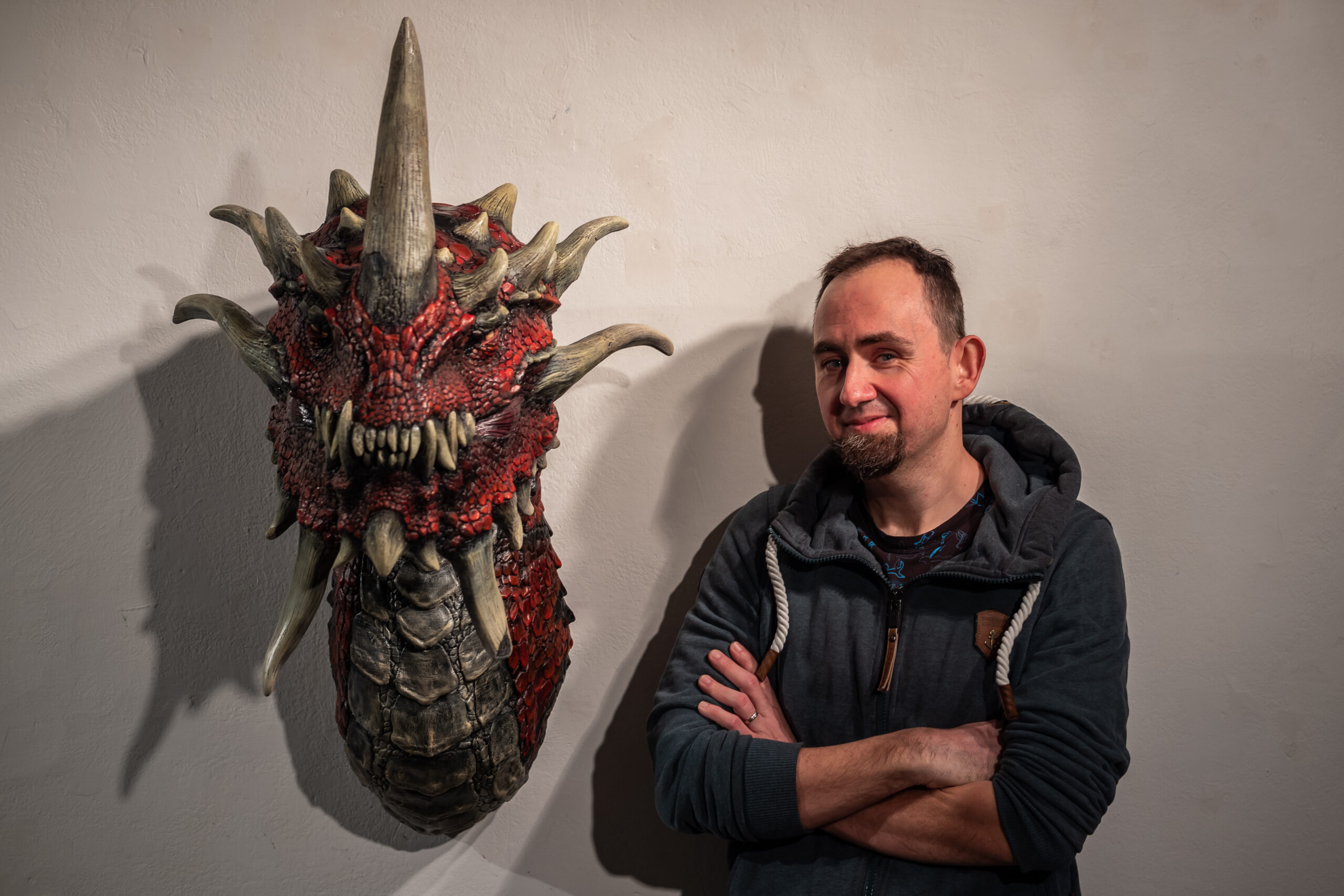
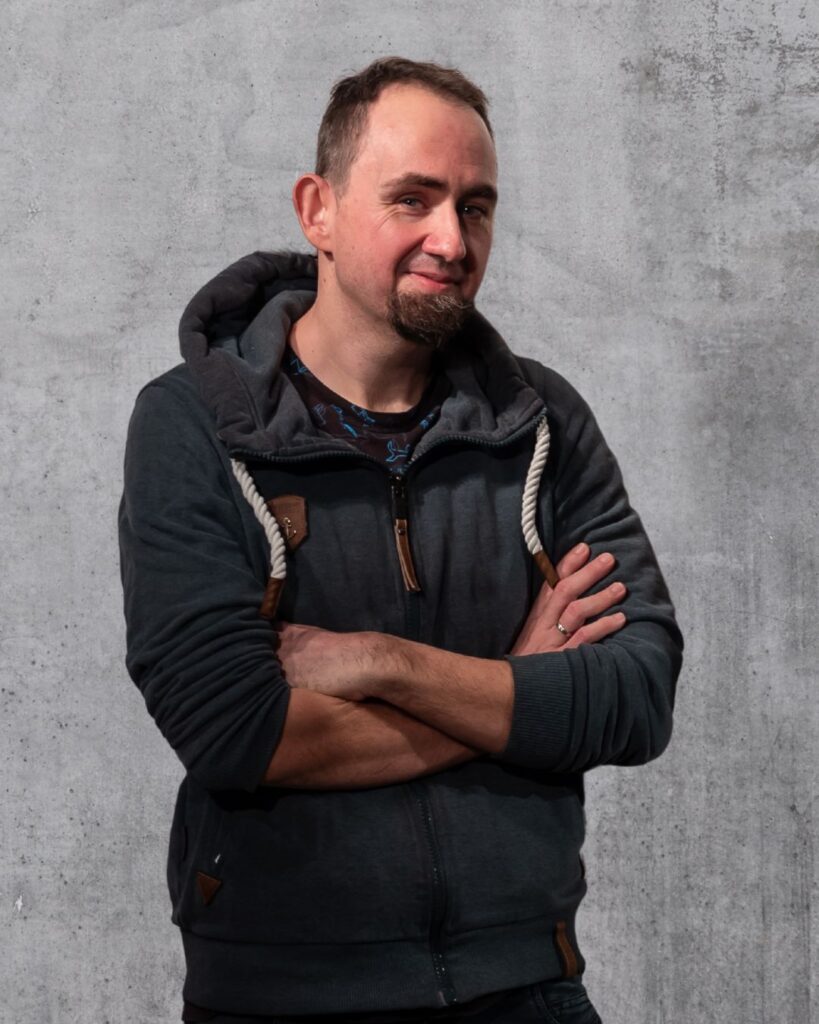
Winton Afrić has been drawing dragons since he was three years old. Today he sculpts them digitally, scale by scale, into collectible pieces that seem to pause for a breath before they move. In this conversation, the artist and university professor talks about his way back to the kid inside him, how a creature emerges from a few loose shapes, and why he hopes collectors will feel like children again.
Winton, can you remember the moment when you knew, “I’m going to be an artist,” and not anything else?
I have been creating art for as long as I can remember. The first drawing of a dragon that I have saved is one I made when I was 3 years old. I always wanted to be an artist, and it was always important to me to be able to create the things I imagine. I don’t think there was ever another feasible way for me.
How has your path evolved from your first works to the highly detailed collectible sculptures you create today?
There was a lot of searching, stumbling, hard work and discovery on my path. My work was always figurative, but for a time in college I did surrealist painting. The problem was that the traditional environment I was in tried to convince me that creating fantastical creatures is not really art, so I went through a period of moving away from what I felt and needed to create from the inside. Eventually, when I started teaching, I decided to make my art according to my own convictions and what I feel is right, and I went on a journey to get back to the kid in me. Nowadays it is extremely important to me that the works I create are something the “kid Winton” would be happy with.
Your characters look as if they come from their own mythology. Does the story appear in your mind first, or does it develop while you are sculpting?
It depends from work to work. Many times I just start sculpting and react to the shapes I make. I start very loose and abstract and let myself react spontaneously to what I see, and then something happens: a character or a creature emerges. At that point I start to ask myself: Who might that be? What is its story and background? What are its motives and purpose? What is it doing? Where is it going? And then I try to answer these questions in my work. It is very important to me that my sculptures have a lot of personality and character, that they convey emotion and intelligence, that they look like you could hold a conversation with them. Although sometimes a short one.
Which themes, emotions, or questions of life keep returning in your sculptures?
I love to give my creatures personality and have them address certain emotions. Some of them are serene and calm and convey the feeling of enjoying a beautiful starlit night or a summer breeze. Others I want to be more intense, conveying the raw power of nature or the danger and fear of the unknown. For many of them I try to tap into the primal gut feeling you get when you face an animal in the wild, or the deceptive moment when an animal appears approachable but the reality is a different story.
As far as questions go, it is often prejudice and subjective assumptions that I like to challenge. For instance, by showing a gentle mother dragon, when for many people dragons have a purely evil connotation. I also like to show beautiful, majestic fantasy creatures that inspire a sense of awe and a thirst for exploration, a sense of belonging to a different world, one more in tune with nature than our own.
How does a new figure begin for you: with a sketch, a 3D draft, a random image in your mind, or a completely different impulse?
A new figure typically begins with getting a cappuccino, playing some music and pushing digital clay around. Sometimes I dream something, or think about sculpting something before I go to sleep, and then try to translate that half-dreaming vision into clay in the morning.
Can you describe your typical working process from the first draft to the finished sculpture, including a step that outsiders usually don’t even notice?
Usually I start by defining the primary shapes, the flow, rhythm and movement of the sculpture. Mostly I’m looking for a graceful moment that appears as though life was caught in an instant and we are witnessing it paused, and it could continue at any second. After that, a lot of my work comes down to building a strong structure by thinking back to various animal anatomies and creating forms that feel believable and alive. Then I use smaller and smaller tools and gradually transition into details.
Many of my sculptures feature scales, which I shape individually by hand. Most people don’t know or even think about it, but I do everything by hand using simple brushes, which is closest to working physically even though I mostly work digitally. This way I believe I have the most control to achieve the most lifelike flow and detail in every aspect of my sculptures. I also generally don’t use any references while I work. I may look at some before or after sculpting, though.
Many of your works move between pop culture, gaming aesthetics, and classical sculpture. How consciously do you play with these references?
I don’t consciously think about it. It’s a mix of everything in my mind. Most of all, I approach sculpting as a process of discovering a lifeform or a character. I do think that coming from a traditional background and having studied art history, design and visual communication on one end, and growing up playing computer games and board games and reading sci-fi and fantasy on the other, puts me in a great spot, where all these influences mix below the surface to create my own inner world.
What do you hope a collector or viewer feels when they stand in front of one of your sculptures for the first time?
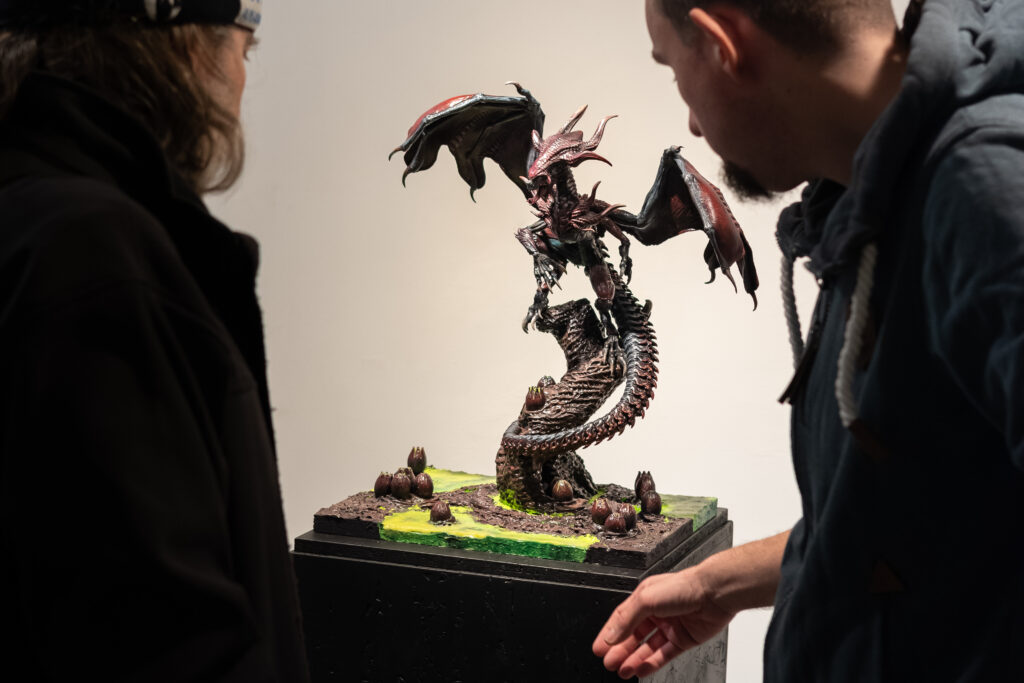
The greatest thing for me is when my work gets someone to feel like a kid again. I love seeing people pat my dragons, put their head in an open jaw, give them a gentle stroke on the nose and the like. That moment of childlike wonder is what I enjoy most when creating them, and I feel it is important for grown-ups to be able to feel some of that joy again. I’m always happiest when my works manage to resonate with people like that.
You teach and are at the same time a practicing artist. How do these two roles influence each other?
I think teaching while doing is exceptionally beneficial, and I believe I’m a better artist because of my teaching than I would be without it. Teaching forces you to solve problems from someone else’s perspective, and that becomes learning and experience for yourself, in many cases experience you would never get otherwise. After teaching for more than 20 years now, I firmly believe it is one of the greatest things an artist can do to further their own development. However, all of this holds true only if you work and create art every day and then teach on top of it.
Where do you see your artistic universe in the next ten years: more in museums, private collections, digital worlds, or in a completely different place?
Recently, and completely out of the blue, I started working on a computer game that will feature my dragons as the main characters. This is very dear to me, because people will be able to access them as more complete beings, personalize them, create their own characters and play with them. That brings me great joy. The project is also filled with other amazing artists working on other aspects of the game, and I’m thrilled about the collaboration.
On a separate and equally important note, I would love to see my works exhibited in galleries and museums and in private collections, where they can reach people and touch them. I want my sculptures to have a life, touch other people and make them happy. That would make me the happiest. As a side note, I can also see them exhibited in a public space like a mall, with a large flow of people, so they can reach many different people of many different ages and parts of society.
More Questions from the Catalog
When someone leafs through this catalog for the first time and comes across your sculptures, how would you explain in one sentence what they are looking at?
A fantasy of life frozen in a moment, to experience and enjoy.
Many of your figures seem frozen in the middle of an invisible movement. What fascinates you about this “in-between” moment, between attack and calm, between human and creature, between fantasy and reality?
I think these are the moments where a lot of communication occurs without words spoken or actions taken. It is the perfect moment for me to place my sculptures in, because that way I feel they can speak without speaking and touch without moving.
Your works combine an almost archaeological attention to detail with a very contemporary, pop-cultural visual language. Where do you encounter your motifs in everyday life: in museums, in games, on the street, in dreams?
I believe I encounter motifs everywhere. It can be anything: a face someone makes in a conversation, something I see in the clouds or in the scattered leaves on the ground when I walk my dog. Sometimes it is more elaborate, like photos I come across while reading an encyclopedia on lizards or a book on various types of fish and fishing. Other times I’m inspired by an idea I read or by the work of other artists. For example, when I heard people speculating that a dragon monster from the Upside Down could appear in season five of Stranger Things, an image instantly popped into my mind and I had to make it.
If you could choose an ideal place for your sculptures, what would this space look like? What kind of atmosphere, what kind of light, what kind of people?
I think my sculptures fit in any room where people resonate with what they are. I can see them decorating a traditional pub with lots of wood on the walls and a high ceiling, with my trophy busts distributed along the walls as if you were in a fantasy tavern. I can also see them in game rooms and living rooms of people who love fantasy books and movies, play RPGs or just love dinosaurs and dragons. They stand out most beautifully with spot lighting that accentuates them like a prized collection. I can also see them on the wall of a kid’s room or a family room, or on a shelf close to The Lord of the Rings or Game of Thrones books. Equally, I can see them in a museum or gallery, displayed on dark walls and accentuated by light.
I do believe my recent Alabaster and Gold and Ebony and Gold sculptures have a somewhat different vibe and would fit many modern spaces better than my older, more naturalistic-looking pieces. Each of them has an aesthetic that is dear to me, but I see them in different settings with different purposes.
You create figures that often appear strong, ready to defend themselves, sometimes threatening, and at the same time very vulnerable. Which facet of being human do you hide in these “creatures”?
I think all of my creatures carry a facet of intelligence and emotion, and a purpose, and therefore they might represent a visceral embodiment of a facet of what it is to be human: unfiltered and raw, closer to animals and to something primal than what we are accustomed to seeing. Today we have layers upon layers of nuance and finesse, and most days, looking at people, we have to figure out who they are. In my work I take small pieces of this, expose them and try to show them in a more primal, fantastical form, bare for everyone to see, enjoy or shun. Each to their own.
Is there a personal ritual you need in order to start working, something that helps you shift from the outer world into your own inner world?
Not really. I think I am blessed in that I’m on the doorstep of my inner world almost all the time. All my efforts at nurturing the kid inside me have put me in a position where I spend most of my time thinking about things that resonate with my inner world, and that ends up in my art. In that sense, I don’t watch TV, I don’t read the news, I’m very careful about what kind of content I engage with on social media, and I try to keep my surroundings curated so I can stay in this state. All of this helps me operate and keeps me happy. My job as a university professor is perfect for that, because the professional problems I face 90% of the time are also tied to figurative or fantasy art and are therefore part of my inner world.
As a caveat, I might say that putting some music on or having a cup of coffee in the morning, sometimes both, as I start working plays a minor role in getting me 100% focused.
If you could send a young artist off with a single sentence of advice, what would it be?
Practice every single day, no exceptions, go out of your comfort zone and push yourself to think, work and improve.
Discover Winton Afrić’s Sculptures
Explore the artist’s profile and available works at Favori Art, among them Tobi Kadachi – Matriarch, Vor’Gash – The Aspect of Death and Nizzioth of the Desert – Wall Sculpture.