Matthias Hübner, born in Querfurt in 1976, combines black-and-white realism with neon colors and UV effects in his painting. His style of “modern surrealistic realism” moves between intense figuration, experimental technique and emotional openness. Already recognized with awards as a teenager, he first went into music before returning to painting in 2020.
Today he is regarded as one of the most exciting positions in Leipzig’s contemporary art scene. In an exclusive conversation with the Favori Art gallery, Matthias Hübner talks about contrasts, freedom in art and the importance of light.
Matthias, what do you mean by “modern surrealistic realism” – and which motif was the “key” to filling this term with painting?
First of all, thank you for engaging so closely with my works – and therefore with me. To be honest, I can’t remember exactly how the term came about. But it brings together three things I love, which have also found their way into my paintings.
For example, switching from oil paint to acrylic gave me access to other, new colors and above all color effects. I soak up every possibility and experiment until I realize either that I can use it or that “this makes no sense for me.” I couldn’t care less whether it is a classical technique, whether I fit into academic categories, or whether I might lose a conservative viewer or two.
I love realistic depictions, especially of people. Nature has made us into beings that can express more emotions than any other – at least I don’t know of one – through glances, facial expressions, gestures, posture, and our whole appearance. The mere existence of the white in our eyes gives us possibilities denied to other creatures.
Combining these two attributes, “modern” and “realistic,” in my paintings results in a certain surreality. And just between us: as a self-confessed fan of Dalí’s work, I can live with that quite well.
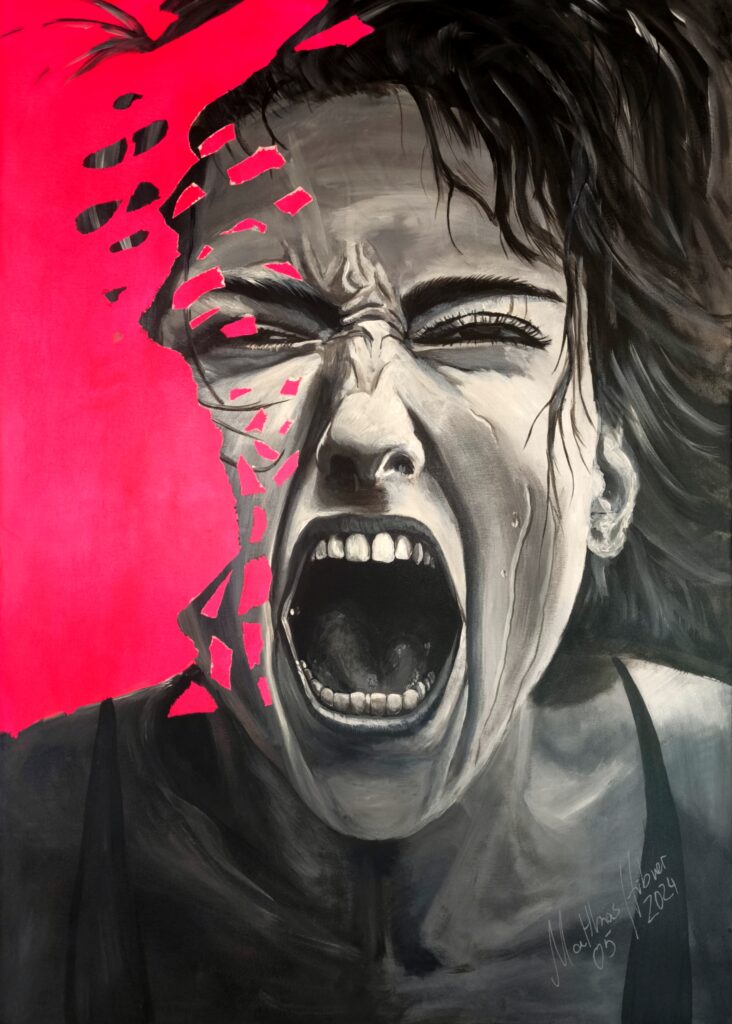
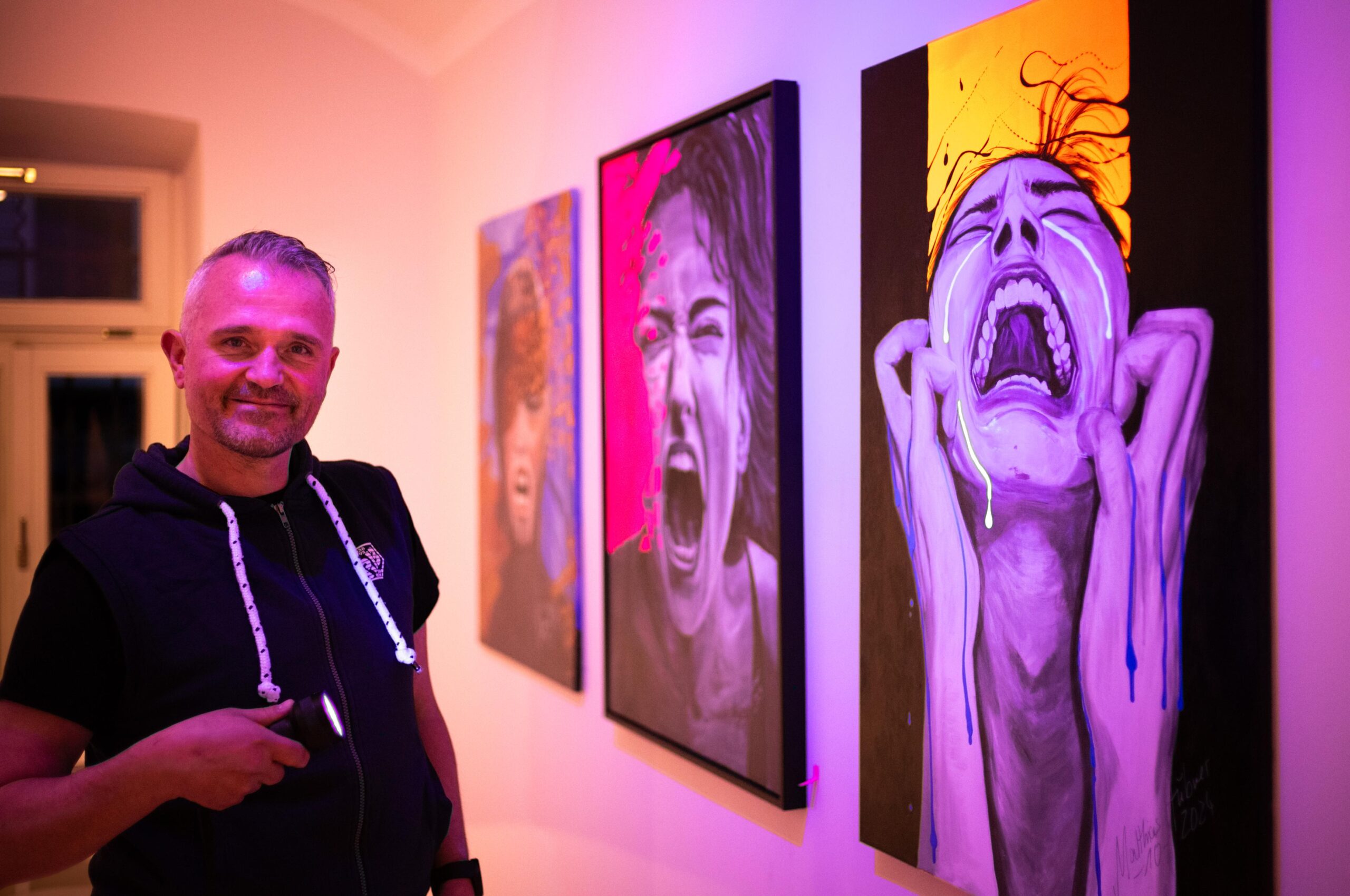
Although it was a process, there is one painting that was decisive for this way of working: “NEON SCREAM,” in which I used neon paint over a large area for the first time. I primed the canvas in neon pink, then partially masked it off and painted the portrait. During the process, I no longer even knew exactly where I had masked. As one of the very last steps, it was a surprise even for me.
Today there are other, newer paintings, such as “RUHE” or “GENERATION,” into which a bit of Expressionism has crept as well, but “NEON SCREAM” will always hold a special place in my own history.
How do you manage the contrast between graphic rigor and luminous color so that the painting doesn’t become a mere effect but keeps its tension?
Honestly, I don’t consciously manage the contrast by calculating how much of what has to be where in the picture to keep a certain balance. It’s more a kind of flow I enter. I notice pretty quickly whether the result will be one I’m happy with or one I’ll paint over again. It depends on whether the picture flows through my hands onto the canvas or whether I have to “struggle” through its making.
That happens too. I have an idea that excites me at first but simply doesn’t work on the canvas – or at least I can’t get it to work. The fact that I no longer make preliminary drawings or sketches supports the flow, but it also increases the risk that it might not work. So far, though, the ratio is bearable.
What role does UV light play for you beyond the “aha” moment? What should become visible in “night mode” that stays hidden by day?
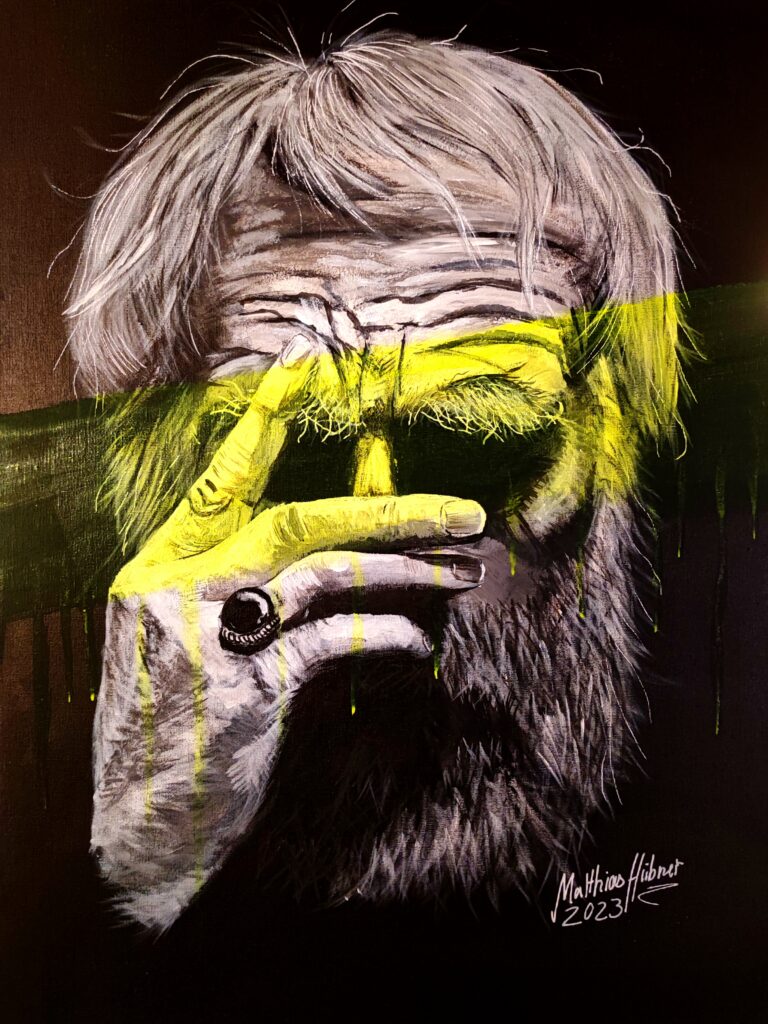
I still remember the first paintings in which I used neon paint: “NEON SKULL” and “ALTER MANN” (Old Man).
With both, even though they were created at different times, I had the feeling at the end that something was missing. They seemed too boring, too arbitrary to me, so I applied the colors – and developed a credo that still carries me today: “Don’t be afraid of destroying your work.”
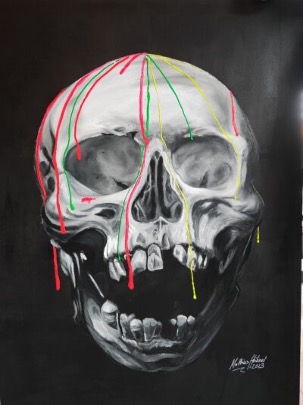
While the neon colors in “NEON SKULL” work both by day and at dusk, when you light the painting with UV or even simply blue light, the effect in “ALTER MANN” only appears at dusk under the right light – an “aha” as well as an “oh, I didn’t expect that” effect. It changes how the painting is perceived.
Interestingly, knowing how the paintings look under that light also changes how they are perceived under completely normal light. Viewers who know both effects now know the secret of each painting – one others haven’t uncovered yet.
Equipped with UV flashlights, visitors take on the role of explorers. They have that role anyway, but with the “tool” of a flashlight, the gallery and I hand them something that clearly gives them this task. A visit to a painting gallery thus becomes far more a discovery of art than simply looking at it. There are a few paintings in which I have hidden a few things in the UV spectrum, but that’s rather rare – and which ones, you can discover for yourself…
“I have to create something every day. Days on which I don’t manage to have always been wasted days.”
How do you know that a face or a gesture “carries”? What criteria do you use to choose references – or do you invent them?
It is hard for me to answer questions in an interview. Partly because I probably think about things less than some people would like.
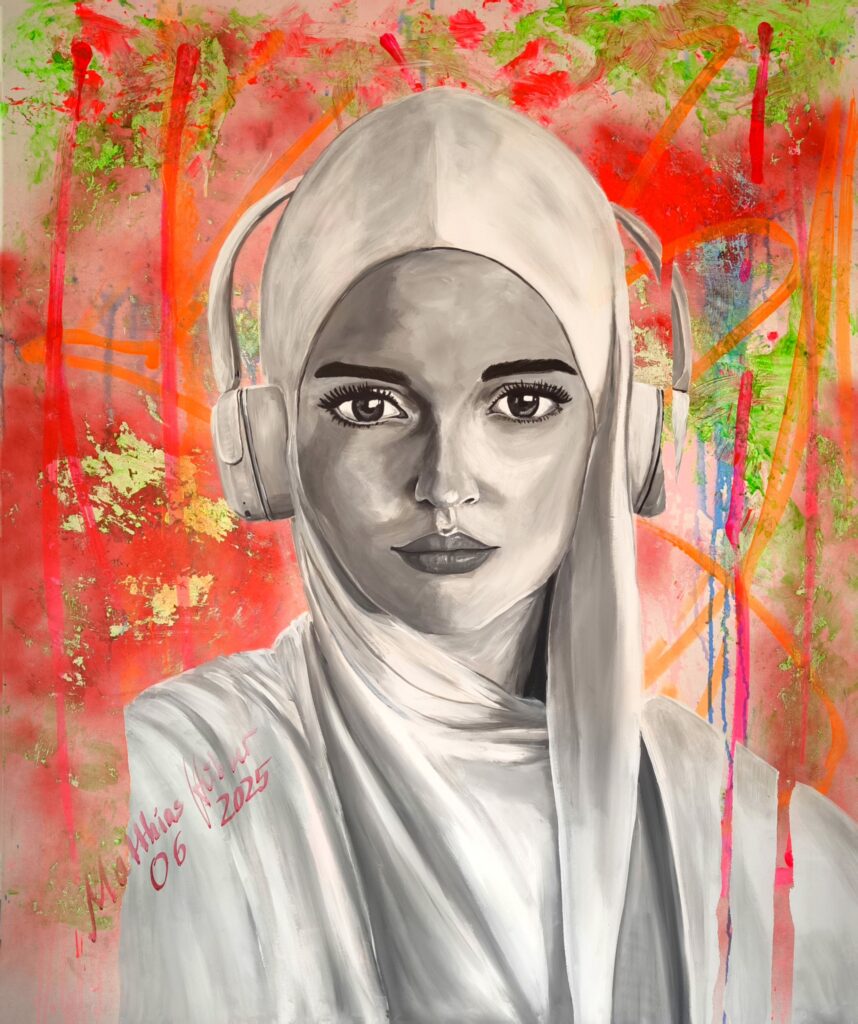
So there are no clearly defined criteria for choosing motifs. Sometimes it is a motif that inspires me and sets the construction process in my head in motion. The work “GENERATION” is an example.
In a city, I came across a woman wearing the traditional clothing of a Muslim woman. She had a beautiful face, was not fully veiled and was wearing Bluetooth headphones. I was thrilled by how naturally she combined convention, the present day and a bit of revolution. So I began constructing the picture in my head.
It was supposed to feel urban, so I created a graffiti wall in the neon colors that are typical for me right now and placed the painting on it, so that with its deliberately placed interruptions it almost becomes part of the graffiti on the wall. That is one example of how a painting can come about for me. There are countless others, all with one thing in common: when a motif captivates me, I quickly enter the flow I mentioned. Maybe that is a kind of selection of motifs. Maybe even mine…
You returned to painting in 2020. How does this biographical turning point become a formal decision for you (palette, composition, pace) without turning into a mere motif?
2020 was a pivotal year for me. The Covid pandemic, the cancellation of all concerts, the enforced interruption of my own children’s development, and then, at the end of the year, the diagnosis of an illness that even our modern – and in my view genuinely good – medical science reaches its limits with.
I was pumped full of the stress hormone cortisone and at the same time told to relax completely. I couldn’t continue working in the studio because I could no longer hear anything – and I am a textbook case of ADD, so I can barely concentrate on things that don’t interest me. I find it hard to follow conversations, so I don’t like having them. So I returned to the talent I was born with and set up the easel that hadn’t been used for almost two decades. I found relaxation and was – and still am – able to lose myself in it completely. It often feels as if I become an observer of the reality around me while capturing another one on a canvas.
Sometimes I carry masses of ideas in my head that have to come out. Then I can concentrate even less. It must be awful for the people around me when they want to talk to me then, but those closest to me know me, and I can rely on them.
I have to create something every day. Days on which I don’t manage to have always been wasted days. Whether it’s music or visual art doesn’t matter to me. Both satisfy me in my innermost being and let me bear the world around me a good deal better – but above all, they let the people around me bear me a good deal better.
“Don’t be afraid of destroying your work.”
Could you outline how a typical painting is built – from the underdrawing to the varnish? Where do you deliberately allow chance?
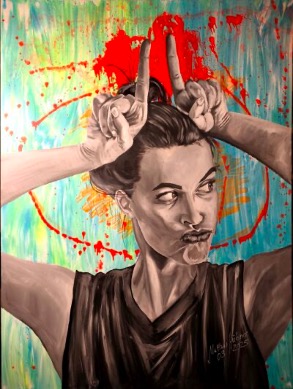
Right now I am trying to break exactly this routine. I’ve found that I work better when I allow more spontaneity even at the underdrawing stage. With the painting “DIABOLISCH” (Diabolical), I tried the underdrawing several times, and something was always off, until I dropped it entirely and simply painted the woman. Starting from the mouth, I painted her in the first step in as much detail as you can see here.
In this painting, I only applied the background after the main motif. Since then, I leave out the underdrawing or reduce it to a minimum; sometimes it even starts without a brush, with me simply creating a rough structure of the picture by hand, just like children with finger paint. It is wonderfully liberating – try it!
In general, I allow very little chance, even if it seems that way. However, I do deliberately let changes happen during the process – sometimes I even swap the main motif after I have already started a painting. Is that chance? I don’t think so; it is more a basic trust in my aesthetic sense.
Do you work in cycles? What sequence or hanging (day/night, spacing, lighting) do you think is needed for the duality of your works to work in a space?
That’s hard to answer, since my current cycle has been going on since 2020. It’s different from music, where you are subject to cycles dictated from outside. You write songs, then there is a recording cycle, then one for mastering, usually in parallel one for artwork and promo materials, then the deadline that determines the release, which in turn determines the cycle of active PR and therefore the concerts – and at some point it starts all over again.
Unfortunately, a lot of that is really no fun, at least for me: writing lyrics, giving interviews that, unless you’re a superstar, keep asking the same questions, organizing band rehearsals in which you notice how important – or unimportant – it is to the others. I have had a complete album finished for almost a year but have no desire for the further cycles. So whether anyone will ever hear it is still open.
When I paint, it’s just me. I decide when I paint and which picture. And there is a decisive difference: I had to learn everything musical, but painting is something I have simply always been able to do. That is why I resist being called a self-taught painter, because I didn’t have to learn anything at all – and if you measure the value of creative work solely by academic degrees, that says a lot about our society and its inability to judge art on purely personal and individual terms. In music, on the other hand, I am self-taught, like many others who produce wonderful things.
Since I don’t attach a message to my works that I want to convey, I like to let many people take part in the process when presenting the paintings, or to ask for their opinions. Galleries have great experience in their own spaces here, which should not be underestimated.
Hanging the paintings in chronological order is certainly never wrong, but it isn’t very creative either. Of course, most paintings come alive when the room can be darkened a little and lit with the right light – but sunlight also contains UV, which makes the colors glow. Since I am still at the very beginning, I often draw on others’ experience and respect it accordingly.
Name one painting that sums up your poetics – and briefly explain why.
One painting? That’s mean.
All right, I’ll pick one of the more recent ones.
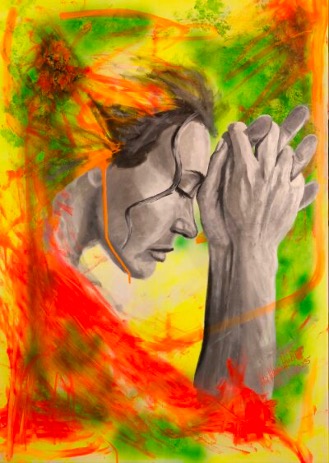
The painting “ADHS” (ADHD) from August 2025 shows well how I have developed and how I work today.
Here I first created the background with my hands in latex gloves. If I remember correctly, I had planned a different main motif, and the canvas stood in my living room with just the background for several days. Working with my hands, without the “interruption” of a brush, gives me the feeling of a better flow into the picture.
I don’t think about how a particular color might work in a particular place. I just do it – and it is important to be quick, to put an idea into practice as soon as it appears. If I wait, the execution no longer comes from a flow but becomes rational – a “detour” from gut to hands via the head, which hinders art itself.
I started the figure around the eyes, then the arms and hands. That seemed logical to me, since it gave me reference points. In hindsight, working this way was a great decision: while painting the arms, I realized that my original aim of painting the woman – or at least her portrait – completely could drain the picture of its energy. So I decided to let the colors that define the background become part of the person too. A person who seems calm in herself but cannot escape the explosions of color around her; they are part of who she is. I applied the suggested sleeves, like the background, with paint directly on my hands.
I would be glad if people who also have AD(H)D recognize themselves in the painting. I think that without it, it is hard to understand – but it is also completely open to one’s own feelings and interpretations, regardless of the title I gave it.
Which of your formats do you think suit first-time buyers, and which suit curatorial contexts? How do you feel about editions or works on paper?
Art is subjective. Different artists speak to different people with different works, often at different times. So it is pure coincidence of emotion, space and time when a work meets a person who feels connected to it – in my case, to the painting.
If, like me, you often give a chance to the belief in fateful encounters, then it is exactly that moment that makes the decision to buy a work. I think first-time buyers are more emotional, almost more honest about their feelings for an artwork than professional collectors – it lies in the nature of things. For most of them, academic assessment and economic potential play no role, or only a secondary one, when buying. So to first-time buyers I would say: “If it speaks to you and you can’t tear yourself away from the work, trust fate and commit – no matter how big or how colorful it is, or what others say.”
For curatorial purposes, it is somewhat more complex. Other premises come to the fore: uniqueness, the context of the exhibition, the specialization of the gallery or the catalog. I myself think the more recent works are the more exciting ones, because I have found my own signature and am developing it further. Let’s see where it takes me.
Editions give more people the chance to take part in art. I like that idea, especially since it can also add value to the original. My medium at the moment is acrylic on canvas; I also like working with chalk on cardboard, but I currently lack the time for it. I can well imagine editions of an original on high-quality paper, but they should be at least A2 size (approx. 16.5 × 23.4 in).
Which themes and collaborations will you focus on over the next 12–18 months?
Since I generally don’t plan when I tackle which theme, there is no outlook for the coming months either. Not even for the coming weeks. But for almost five years there hasn’t been a single day on which I didn’t have at least one motif or picture in my head that I wanted to realize. I have also worked on several in parallel.
I have a wish, or a dream: one day I no longer want to have to stop working at the easel and go to bed so that I can drive to a nine-to-five job the next morning. I am a night owl and always have been. In the early 2000s I built myself a studio and painted it completely black inside – I simply worked better, because my thoughts were freer. On vacation, my daily rhythm usually turns 180 degrees. You can imagine what a challenge it is to get out of that when the vacation is over.
I am open to collaboration of any kind, but I also know I am probably not an easy person. I am probably not a classic team player, but I meet every colleague with a high degree of respect. That is simply a foundation on which relationships can be built. Self-importance has never been my virtue.
Short Profile
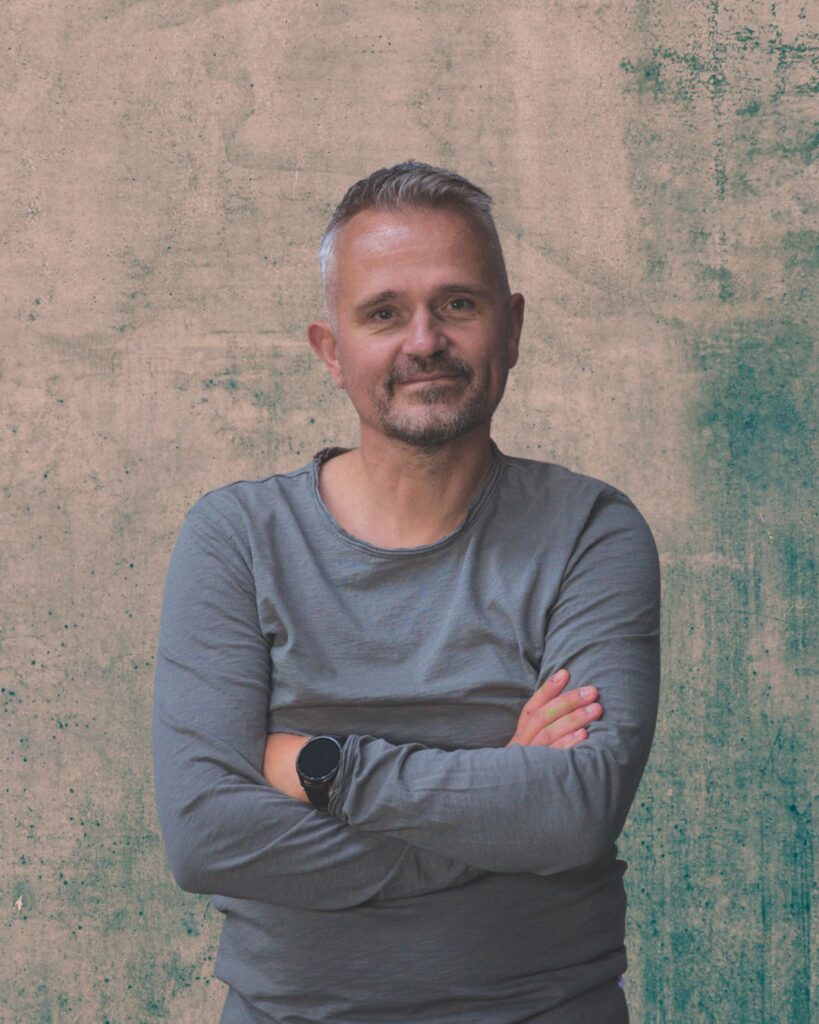
Name: Matthias Hübner · painter
Style: modern surrealistic realism (figuration × neon × UV)
Media: acrylic, chalk; UV-reactive layers
Themes: people & expression, spirituality, day/night contrast
Recent: solo exhibition in Leipzig (2025), awards and further shows
Instagram: @matthiashubner.art