We look for faces. In a crowd, in a photograph, in a picture. A few cues are enough for us to recognize a person or at least sense their presence: the position of the eyes, the tilt of a head, the line of a mouth.
With recognition, reading begins. We perceive an expression, look for a mood, imagine a story. Even a small shift can change how we see: a covered gaze, an unfamiliar color, a line running straight across the face.
In painting, such interventions become part of the encounter. The face remains recognizable and, at the same time, resists a clear description. We see a figure, a painted surface, and the tension between the two.
In the work of Christine Graf, Rike Wölke, and Matthias Hübner, we can observe how differently this tension can be shaped.
A Face Raises Expectations
We approach a portrait with the questions we also ask of people: Who is this? How does this person feel? The picture offers hints but leaves them open. A lowered gaze can read as withdrawal, as concentration, or as an incidental moment.
Painting adds another layer: it decides what becomes clear and what dissolves, where contours close and where color runs past a form.
In this way, our own expectations become visible too. We want to understand an expression, and we notice how much we read into the face ourselves.
Christine Graf: The Figure in Context
In Christine Graf’s “The Love Letter” (2017, oil on canvas, 80 × 100 cm), a young woman in a white blouse leans in front of deep blue velvet curtains. In her hand she crumples a piece of paper, the suggested love letter. Next to her, a clown figure in a red cap steps out of the half-darkness.
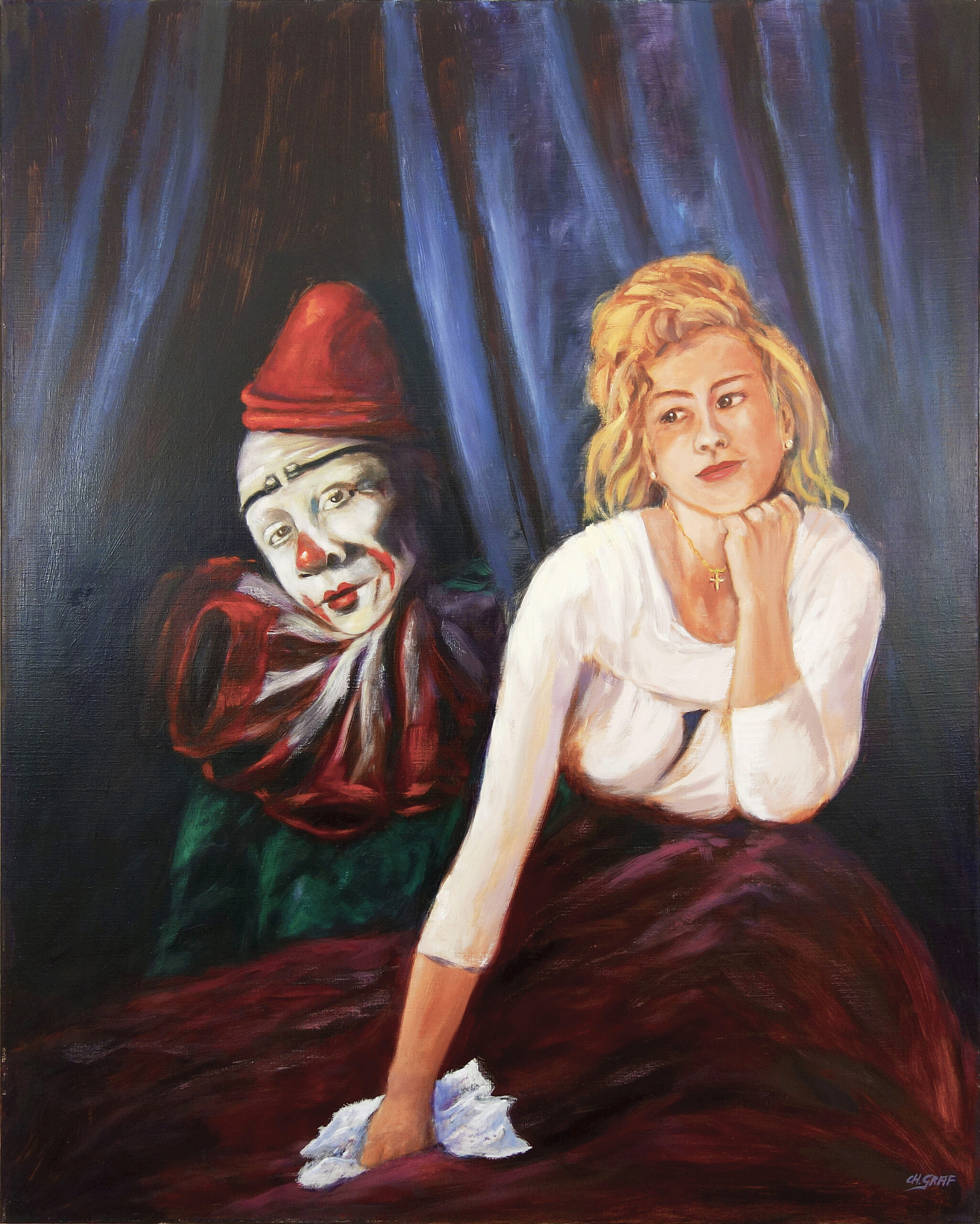
The title points to the moment after reading: aftermath, doubt, longing. The clown figure stands in the room like a counterpart. The clown’s face is lit coolly, while the woman’s skin appears warm. Warmth and cold, play and seriousness meet in a scene that recalls a stage set.
Here the mask becomes a figure. The clown’s makeup carries an expression and holds something back at the same time. It shows that outward appearance and inner experience do not necessarily coincide.
Our view of the portrait widens as a result. We look at the woman and, at the same time, follow the relationship between the two figures: Where do connections arise? What role does her face play opposite the clown’s?
For viewing, this means: let the scene take effect as a whole at first. Then it is worth returning to the two faces. What looks different now?
The figure gains meaning through her counterpart.
Rike Wölke: A Gaze That Sets Boundaries
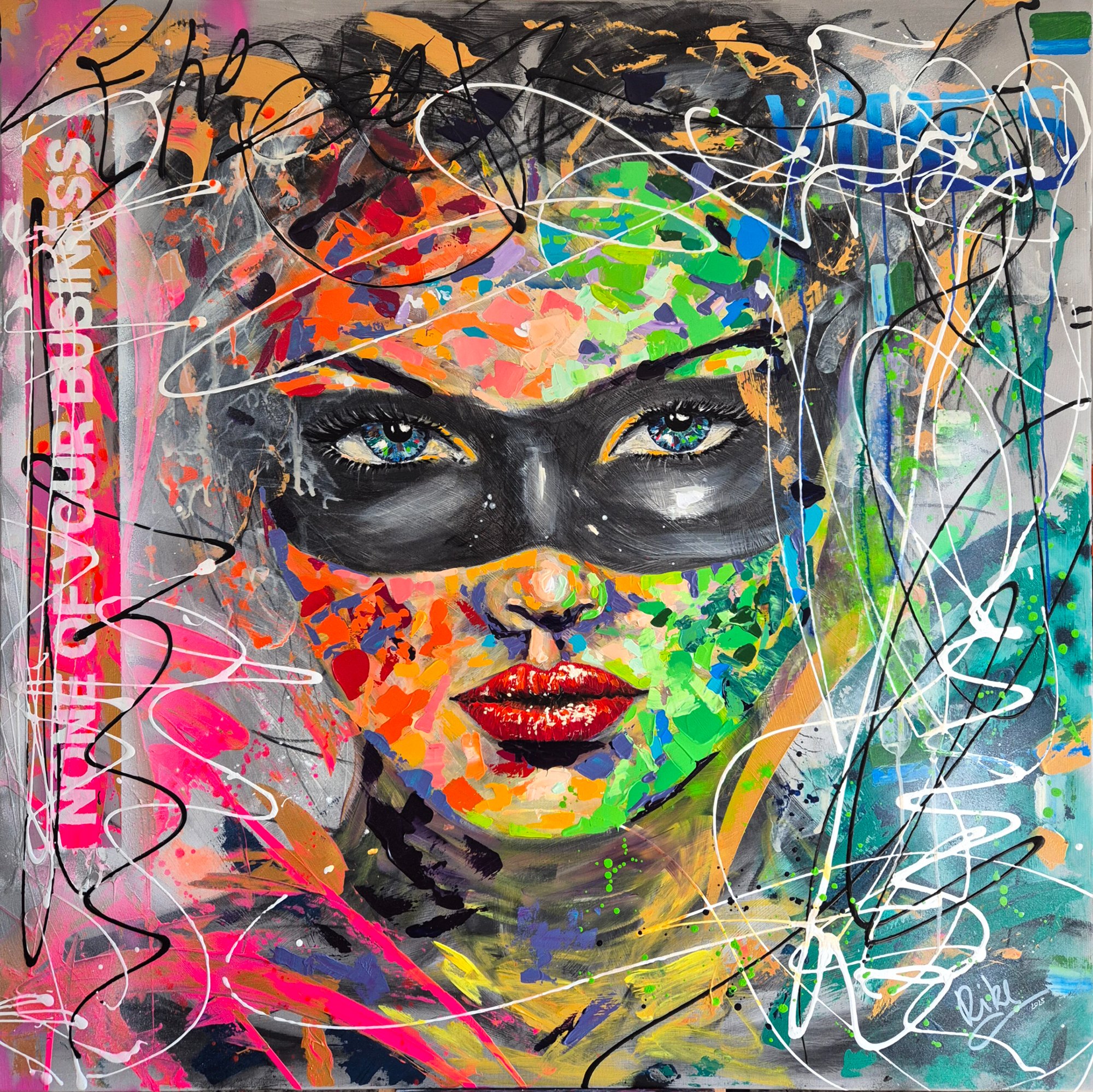
In Rike Wölke’s “None of your Business” (2025, mixed media on canvas, 130 × 130 cm), we meet a direct gaze. Blue eyes, framed by a dark mask, hold our attention. Around them unfolds an intense palette of green, pink, orange, and blue.
The face remains clearly recognizable. At the same time, it becomes a surface where different traces converge. Charcoal drawing, spray paint, inks, and acrylic combine the precision of drawing with free painterly intervention. Lines and color gradients run through the composition and change how we perceive the features.
The lettering “None of your Business” gives this encounter a direction. It sets a boundary for the viewing eye. We can look at the figure, read her expression, and guess at a mood. Access to her inner life remains her own decision.
This creates a tension between visibility and self-determination. The face is present, and the eyes seek the encounter. At the same time, the figure claims a space of her own.
Estrangement takes on a meaning of its own here. Masking, color, and lettering shape an attitude that expresses itself across the entire picture. The longer we look, the clearer our own role becomes: we are looking at a counterpart who returns our gaze.
Matthias Hübner: The Face in the Grid
Matthias Hübner’s “Digital” (acrylic on canvas, neon colors, UV-reactive, 100 × 70 cm) divides a woman’s face into two halves. On the left, it is a calmly modeled black-and-white portrait. On the right, the face dissolves into small squares that drift like a stream of pixels across the glowing red ground.
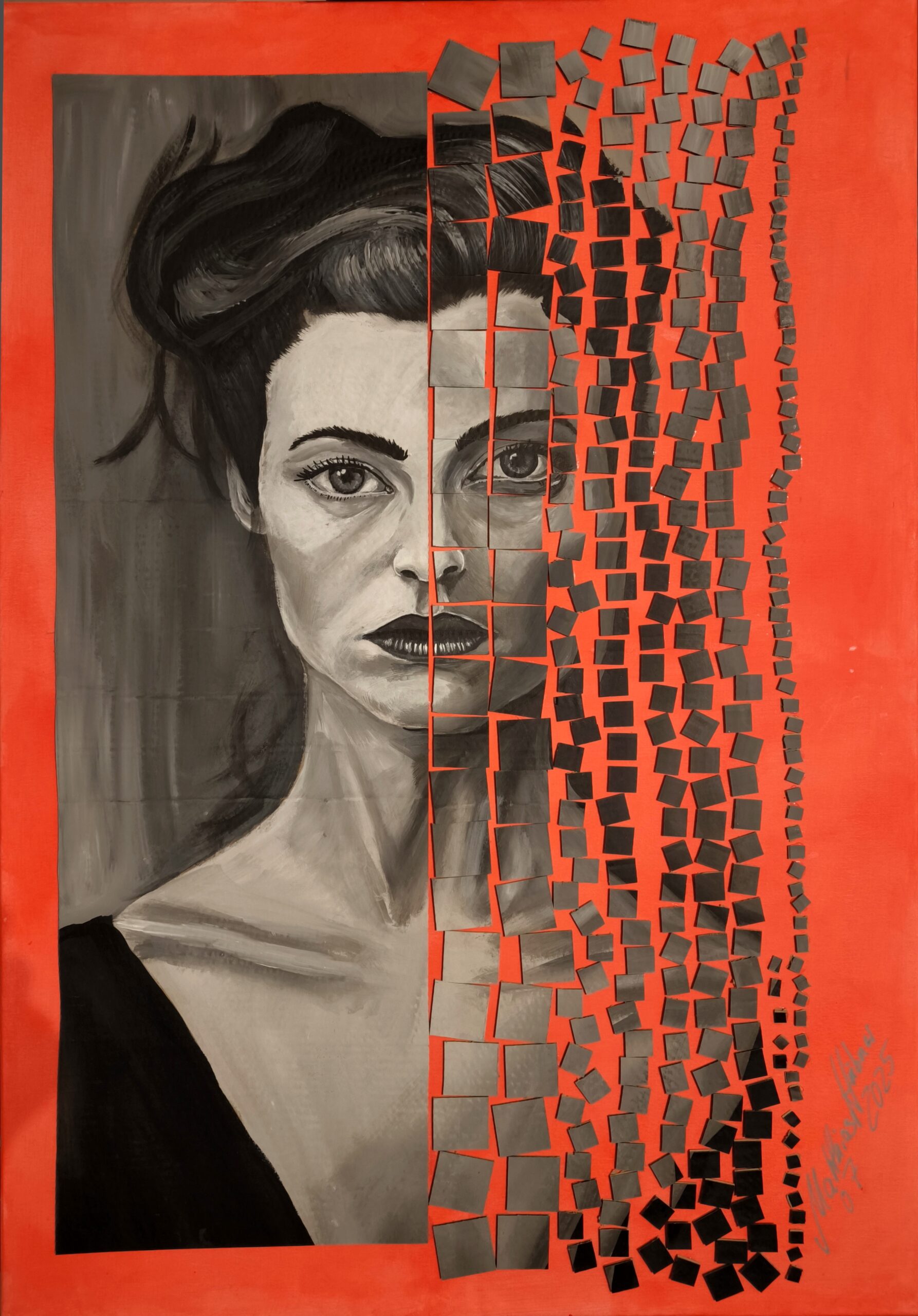
The face offers a familiar point of orientation. The grid structure introduces another order: division, repetition, interruption. It recalls the conditions under which images appear and circulate on screens today.
This makes the way we see a subject too. We recognize a person and, at the same time, notice how her image is built, divided, and altered.
The contrast between black-and-white and red heightens the differences within the composition. The neon colors are UV-reactive, so the work responds to special lighting. The individual layers gain weight; the eye moves between face, background, and grid.
Anyone who lingers before the work can follow this shift. When does the figure seem especially close? When does the construction of the image come to the fore? Which areas hold our attention?
The portrait thus also leads to the question of how images of people are made and how we encounter them.
“Digital” is currently bound to an exhibition and not for sale. You can find more works by Matthias Hübner in the gallery.
Estrangement Changes Our Attention
An unusual color or an overlay can be irritating at first. The face does not fully match what we expect from everyday encounters. We have to reorient our gaze.
In the process, decisions become visible that are easier to overlook in a familiar-looking depiction. We notice a contour because it is interrupted. We attend to the eyes because their surroundings recede. We perceive the surface because it asserts itself against the spatial effect of the face.
In this way, estrangement can deepen the viewing. Its effect arises in the individual work: through the interplay of intervention, figure, and composition.
With Christine Graf, the clown figure becomes the woman’s counterpart. With Rike Wölke, the direct gaze, the masking, and the combination of color and lettering shape an encounter between closeness and distance. With Matthias Hübner, the combination of portrait and grid changes our attention.
It is striking how often a mask is in play: as the clown’s makeup, as dark masking around the eyes, as a grid that breaks a face into squares. Each of these coverings shows and conceals at once.
Each of these works finds its own way to the face.
Closeness Needs No Clear Explanation
A painted face can occupy us even if we do not know the person depicted. Perhaps a posture stays with us. Perhaps it is a tension between the eyes and the rest of the picture. Perhaps a familiarity arises that is hard to account for at first.
Such experiences can be deepened by looking closely. Which visible features trigger the feeling? Does it change with distance? What do we discover when we shift our attention from the face to the entire picture plane?
A second look may also lead to a different perception. An expression that first seemed calm can later seem indeterminate. A trace of color we first saw as an interruption can, on renewed viewing, hold the figure together.
This is a particular quality of the portrait: it gives us a counterpart and keeps the encounter open.
Discover the works of Christine Graf, Rike Wölke, and Matthias Hübner in the Favori Art gallery. We are happy to offer further insights into individual works and their artistic contexts.