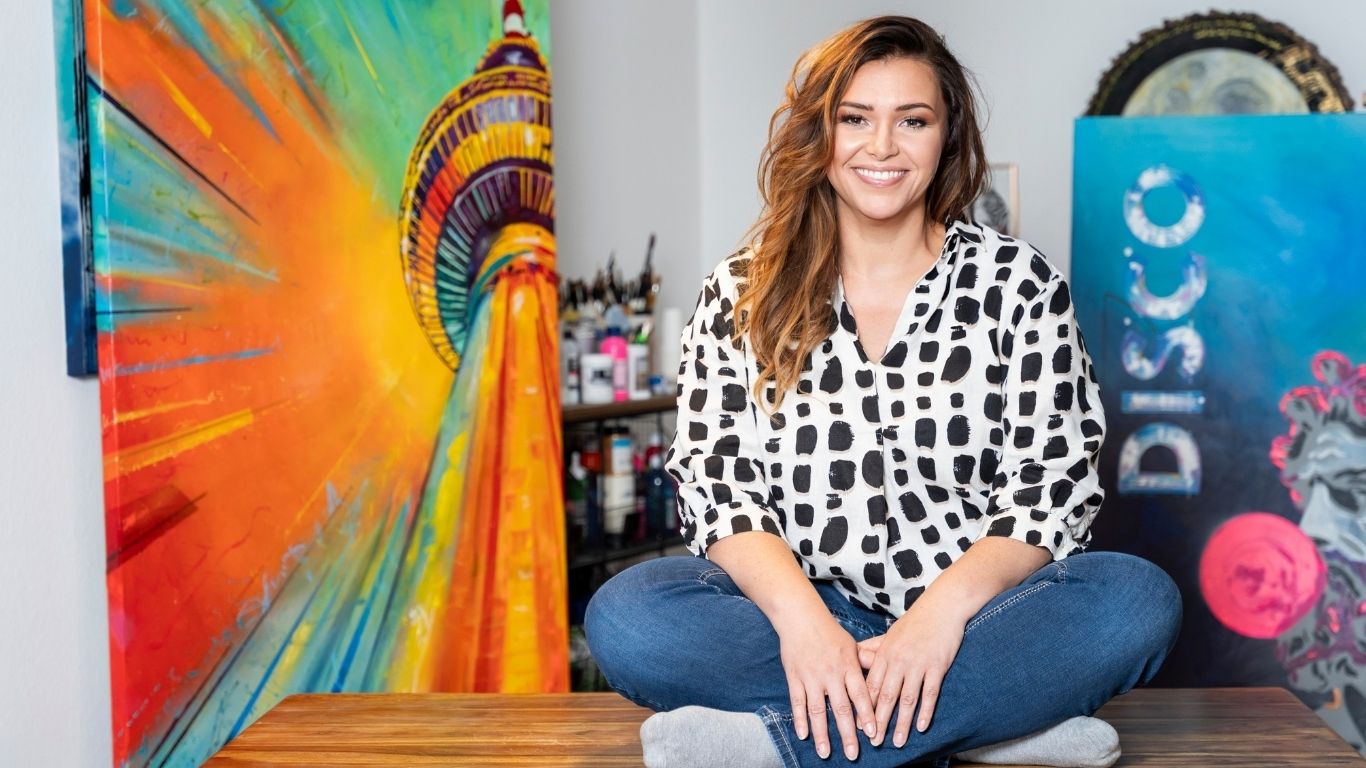
Rike Wölke on pictorial moments between pose and openness, the triad of self-love, vanity and ambition – and why controlled chance moves her painting forward.
Rike Wölke’s visual worlds combine figurative motifs with gestural processes and luminous contrasts. In this short interview, the artist talks about attitude and craft, precision and letting go – and about works in which drip processes and clear lines take on a life of their own.
A conversation for galleries, exhibition venues and curious collectors.
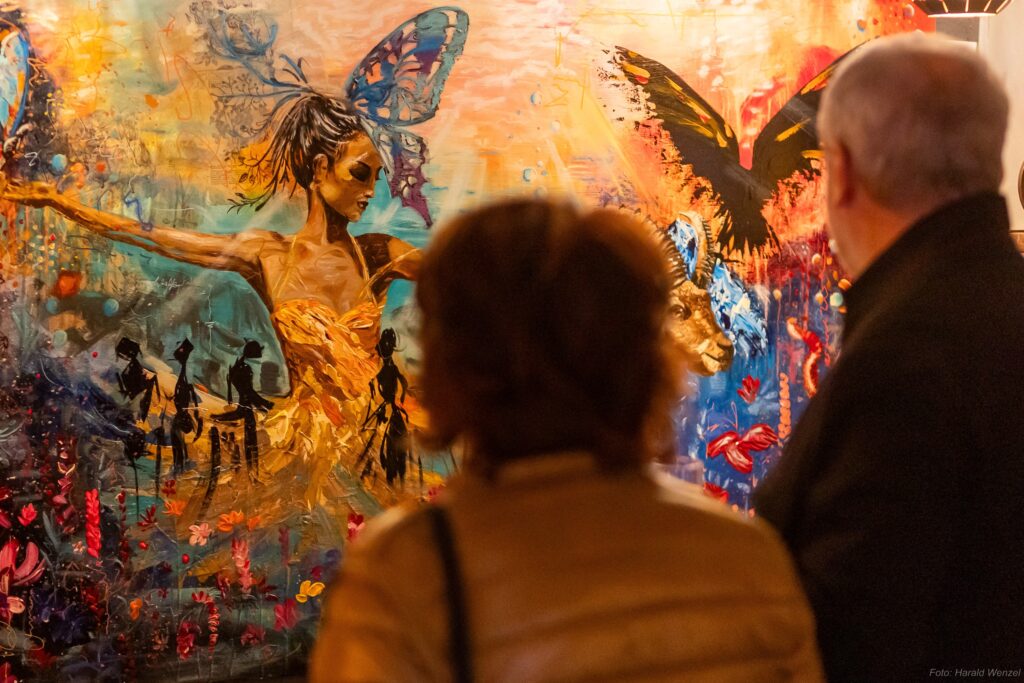
If your painting were condensed into a single pictorial moment – which would it be, and why?
A racing heart between two contradictions
Imagine standing in front of a mirror that does not show you smooth and flawless, but shattered into shards. The mirror isn’t broken because something terrible happened, but because life simply leaves traces – and wounds, too. That is true for every person, because we are made of many facets.
Each of these shards reflects a different image of you: distorted, fragmented, sometimes vulnerable, sometimes beautiful, sometimes ugly. Some shards show weakness or strength – and sometimes brutal honesty.
Exactly this moment – when you realize that you are never just one version of yourself – is the condensed pictorial moment of my painting. I don’t paint the “smooth surface” but the breaks, the layers, the contradictory feelings: self-love, insecurity and vanity, ambition, pride and exhaustion.
Why? Because that is where, for me, life and love become visible. Perfection is mute. Only in the fragment, in the mistake, in the abundance of facets does a story begin to speak.
So my painting is not condensed into a “perfect moment” but into the racing heart between contradictions. That is the moment when you pause, feel unsettled – and suddenly recognize something of yourself. This recognition is a moment of self-acceptance, full of wonderful self-love.
Figure and gesture shape your works. Where does a painting begin for you – in the figure, in the color, or in the resistance between them?
The first brave decision that forces me to be honest
For me, a painting begins where nothing is visible yet – in silence. Just as music does not begin with the melody but with the silence before it. Before a figure emerges, before color breaks through, there is a space that challenges me and demands courage. A vacuum. Almost as if the canvas were looking back. Does the idea in my head have the courage to spread out on a medium? Can I give it shape?
Not the figure, not the color, but the first brave decision. A line that turns out too thick. A shade that looks different than intended. Paint that runs, drips and mixes.
So my paintings do not grow out of certainty, but out of the moment when the certainty of control fails. For me, that is also what is truly human: we do not begin from perfection, but from breaks. That is growth. The painting begins for me where I am ready to give up my own resistance to losing control.
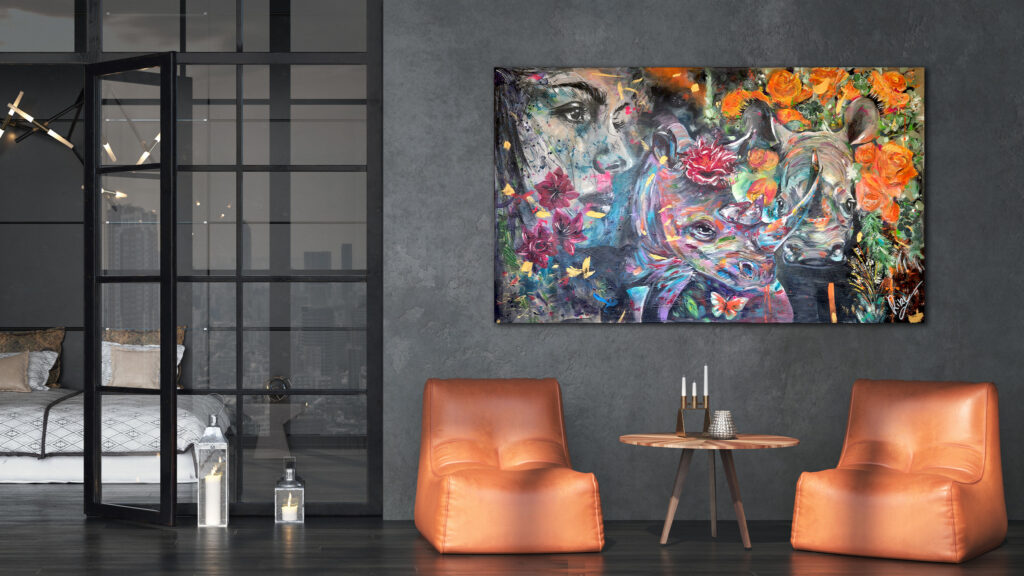
Your works are color-intense and high-contrast, with drip processes. Which viewing habit do you want to disrupt or sharpen?
A focus on habits of judgment
Honestly, viewing habits hardly interest me. Seeing is the shallowest sense we have – fast, superficial, constantly distracted. What interests me is what lies behind the gaze: feeling.
My drips, my color contrasts, my intensity – these are not gimmicks for the eye. They are like notes in a song you feel in your gut long before you understand it. A painting of mine should not ask, “What does this look like?” but, “What does this feel like?”
When I paint, I am not just trying to stimulate the retina. I want to shift the inner lens. We believe we see with our eyes – but in truth we see with our feelings. A drip that seems to run at random reflects exactly the loss of control we are so reluctant to allow when we feel. My color intensity is not decoration but a test: can you bear red shouting at you? Black spreading out? Color being loud?
I don’t want to disrupt viewing habits – I want to disrupt habits of judgment. We live in a culture that celebrates clarity, perfection and control. Drips and wild lines are the opposite. They show that beauty often emerges in the unplanned, in what seems flawed.
Paul Klee once said: “Art does not reproduce the visible; rather, it makes visible.”
That is exactly my aim: that someone looks at my painting and suddenly no longer knows whether they are seeing the painting – or whether the painting is seeing them.
The triad of self-love, vanity and ambition – what inspired you to pursue these forces in painting?
Self-love, vanity and ambition reveal what we often don’t want to admit
I remember a woman in a café – she was trying to take a selfie and looked into her smartphone as if it were an oracle. Everything was in that look: the longing for recognition, the insecurity in front of her own face, and at the same time a quiet strength that said: “I want to be seen.”
Self-love, vanity and ambition are not opposites – they are three sides of the same coin. Self-love is the inner breath that lets us live. Vanity is the shimmer of the surface, sometimes smiled at, but without it we would never feel the need to show ourselves. Ambition is the energy that forces us to grow beyond ourselves – and to go beyond our limits.
I paint these themes because they reveal what we often don’t want to admit. When we perceive vanity, it is often fear. What we call ambition is often a deep longing – for love, for example. And living self-love is often the hardest exercise of our lives.
I don’t paint these forces to give answers, but to make the questions impossible to overlook. Everyone finds the answers within themselves.
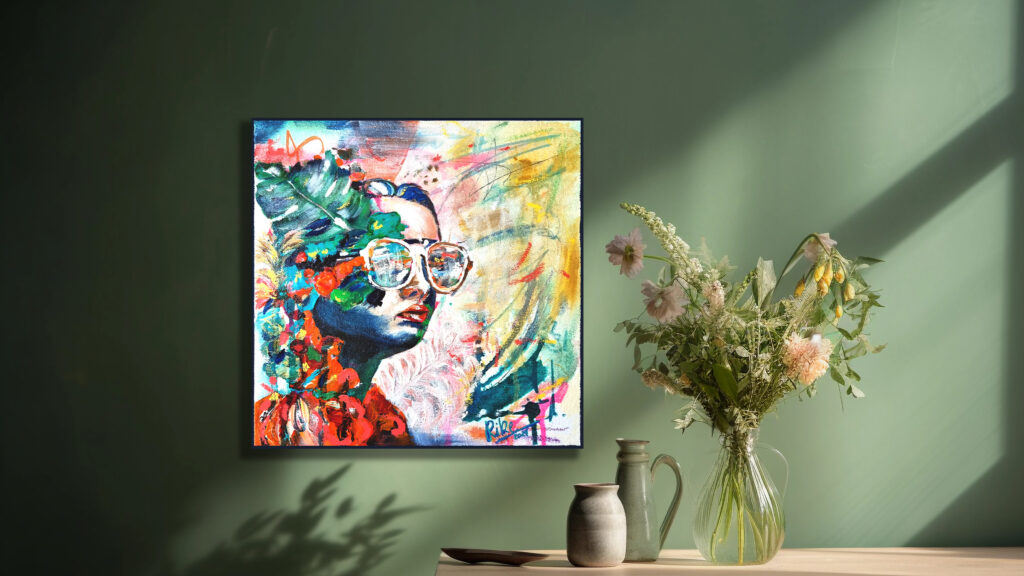
Transformation vs. decoration – when does beauty become existential for you, rather than just beautiful?
Not flawless – but the moment beauty gains depth
Beauty becomes existential when it leads us beyond the surface. At first glance, my works often seem aesthetic, harmonious, almost flawless – the way we know it from the world of filters. But that is exactly where the second look begins: a detail, a break, an irritation draws the viewer deeper.
Just like with people. We see a face that radiates outward, but behind it lie layers of longing, drama, love, anger, doubt and courage. What we first judge as flaws are in truth the facets that make us unique.
My painting does not want to show wilting or decay. I am interested in the moment when we find peace in all this complexity. For me, beauty means consciously choosing the beautiful – not because life is smooth, but because we give it value.
Adorno said: “Beauty promises a happiness that is not there.”
I turn this thought around: beauty is the conscious decision for hope – even when everything else in us is screaming. Therein lies a transformation that makes us optimistic, gives us courage and turns our gaze from the surface to the depths.
So my art is not about decoration. It is about understanding beauty as a process – as the quiet force that lets us grow when we dare to look deeper.
A work in brief: from the ground to the last line – how do you let chance flow into your movements?
The unknown only enters the room when you allow chance
For me, chance is not an opponent to be tamed but a conversation partner. When I lay down the ground, it is like the first word in a dialogue. I leave structures in place rather than flattening them. With every layer, every line, I respond – but chance always has a say. The drips that run, the lines that break out, the play of color that condenses: I could control them, but then I would only depict what I already know. The unknown only enters the room when I allow chance.
I like to compare it to jazz. The musicians have a basic structure, but the magic happens in the improvisation. In my paintings, the ground is the score – and the drip processes are the solos. I follow them, react, sometimes contradict – but I never leave them unheard.
In this way, chance becomes the touchstone of my own decisions: how much room do I give it? How much do I steer? Right there, in between, is where the living begins. That is where the soul of the work lies, and the most beautiful harmony. Only when that harmony arrives for me and I feel a deep sense of fulfillment is a painting finished.
Beauty emerges when control and chance meet – not to defeat each other, but to complement each other.
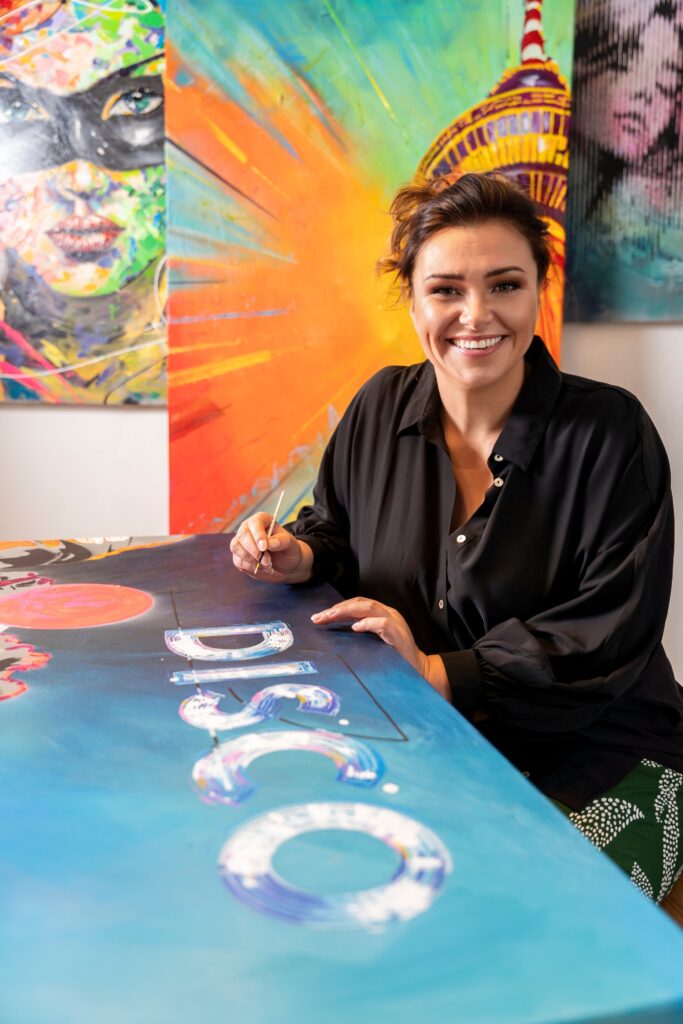
Which so-called “mistakes” do you leave in place because they create truth for you?
Mistakes as helpers
I don’t believe in mistakes on the canvas. I believe in decisions that lead me to places I hadn’t planned.
When a drip runs differently than intended, when a line breaks out or a color tips over – that is not failure but a hint. These traces are honest because they are born not of control but of reality.
Many viewers see perfection as truth. For me, truth emerges where something was unpredictable. A “mistake” shows that life is pulsing in the picture, that it breathes. And from that comes a beauty no perfection could create.
In my art, these “helpers” are allowed to stay – because they simply tell me I’m not finished yet. Every break is a reminder that we are not smooth, not perfect. We are multilayered, contradictory, sometimes raw – and that is exactly where our beautiful humanity lies.
I leave mistakes in place because they force me to let go. It is a hard process for me every time, but the most important one, because they give the picture its truth.
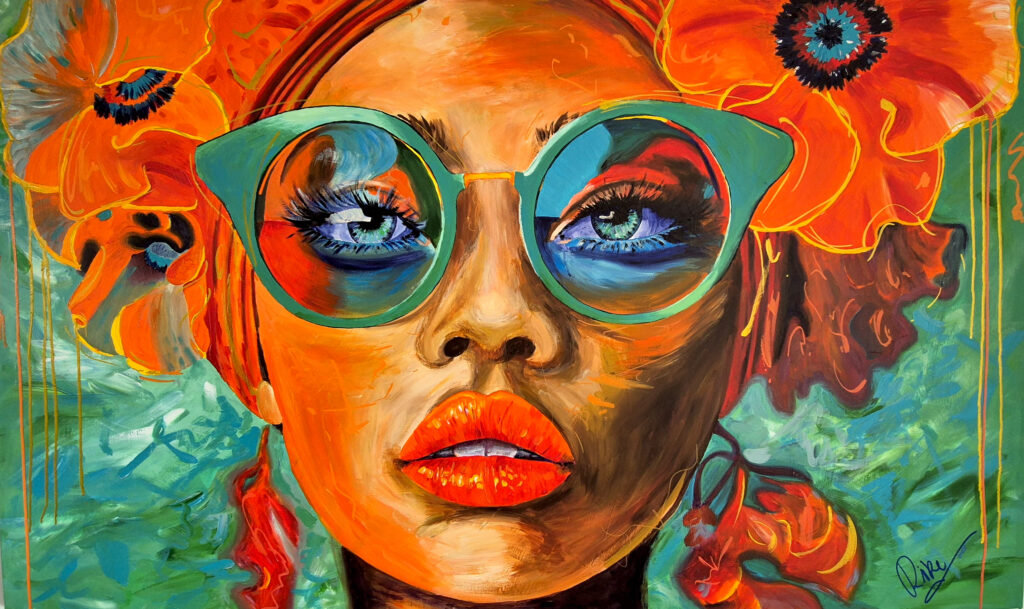
“Selbstliebender Mohn (Mohnmädchen)” – which decision made this painting exactly this work?
Without apologizing
From the very beginning, the poppy girl was not a painting about a flower, but about a decision.
The decision not only to be seen, but also to be acknowledged by oneself. The poppy is delicate, vulnerable – its petals are wafer-thin, almost transparent. And at the same time it grows defiantly in barren soil and glows in a red that cannot be overlooked. That was my artistic choice: to show vulnerability not as weakness but as a source of boundless strength and presence – a presence that vanishes the moment the flower is picked.
In this work there was a moment when I wanted to hold back the brushstrokes – too much red, I thought, too much presence. Then I made a decision, found the courage to let the figure shine without apologizing for her. That made the painting this painting. The motif immediately opens an inner dialogue with the viewer.
Self-love does not come from perfection, but from the choice to stand by yourself with everything – including the breaks, the shadows, the blur. The poppy girl embodies this attitude: she is vulnerable and strong at once.
There is a beautiful quote by Rilke: “Perhaps all the dragons in our lives are princesses who are only waiting to see us act, just once, with beauty and courage.”
This painting embodies exactly that. Not for others, but for herself.
“Mondsüchtige Bienenkönigin” (Moonstruck Queen Bee) or “Pforte zum Paradies” (Gate to Paradise) – where does the line between metaphor and ornament run for you?
Ornaments are form; metaphors are meaning
The line between ornament and metaphor does not run on the canvas but in the moment of looking. First I seduce with beauty – colors, drips, structures, almost like an ornament that simply shines. But then something happens: a detail, a title, a figure tips the whole thing. Suddenly the painting is no longer adornment but a mirror. Just like with people: the world of filters shows surfaces, but depth only begins where we look closely, question and let ourselves be touched.
That is why my paintings are deliberately beautiful, sometimes almost flawless. But this beauty is not an end but a door opener. It invites – and whoever stays discovers metaphors of longing, love and contradiction. Just as we are: multilayered, vulnerable, contradictory. The line between ornament and metaphor lies in the viewer’s decision not just to consume beauty, but to recognize that it becomes existential when it leads us to our own truth.
The line runs where making visible becomes meaning: ornaments are form; metaphors are meaning. In my paintings, the tipping point comes when material, title and a narrative or symbolic anchor come together – then what seems merely beautiful turns into an existential experience. In other words, my art uses ornament as bait and metaphor as a kind of trap (in the best sense): it attracts, holds on and opens an inner space.
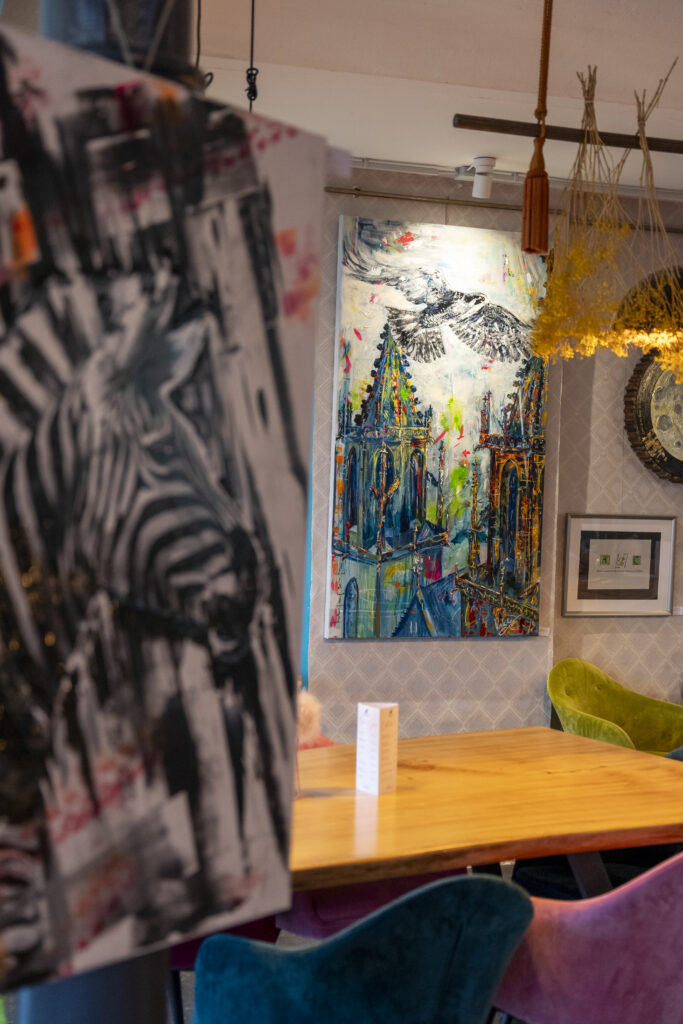
The visitor experience: the selection of your works is curated. Which paths through the hanging do you hope for – which pairs, contrasts or islands of calm should visitors discover?
My paintings don’t want to be ordered – they want to resonate
For me, a hanging is never a rigid concept but always a space of resonance. Even works that revolve around a central motif within a series are independent stories to me. They can stand side by side like two voices in a choir – sometimes in harmony, sometimes in tense dissonance.
What interests me is not what I prescribe, but what happens in the viewer. When someone stands in front of my “Mohnmädchen” and pairs it with “Frei,” a completely different experience arises than when the “Mohnmädchen” hangs next to the “Mondsüchtige Bienenkönigin.” One pairing may tell of rootedness and departure, the other of longing and mysterious strength. I never have any of these readings fully in my hands – and that is a good thing.
Because art follows the same laws that move life.
The law of vibration: everything moves, everything vibrates. Each painting carries a frequency that resonates with the space and the person in front of it. And that is exactly where what we feel comes from – sometimes familiarity, sometimes irritation, sometimes a deep sense of remembering.
Or the law of correspondence: “As within, so without.” A work never shows only its colors and forms – it always mirrors the world of the viewer as well. That is why I am curious about the stories visitors find in my works, not whether they see “my” story.
In this sense, every exhibition is like a new journey. A collector, a gallerist or a visitor will choose their own order – perhaps through contrasts, perhaps through islands of calm. And it is precisely this freedom that keeps my art alive: it doesn’t force, it invites. It turns viewers not into objects but into surfaces of resonance.
In the end, there is no “right” hanging – there are only encounters. And each of them is unique.
Where do you place your practice within contemporary figurative painting – who are dialogue partners or counter-voices for you?
I see my art in resonance with what is happening internationally right now – color-intense, figurative, emotional, sometimes unsettling. But as a natural process. I live in this time and mirror it, absorb it and interpret my emotional world and impressions. I greatly admire the work of Kelly Behun, for example. Her way of weaving spaces and works into an energetic whole inspires me.
But my work is not about a concept; it is about direct emotional impact.
For me, comparisons are mostly difficult. Comparisons serve the ego, and the ego destroys intuition. My art does not arise from measuring myself against the outside, but from an inner impulse – also in the certainty that other vibrations serve the dialogue, even when they seem opposed. I don’t want to measure; I want to let things resonate. Every artist needs their own sphere of impact – and perhaps mine is translating not the trend but my own truth into color, form and themes.
Which formal decision do you want to risk in 2025/26 – and why?
The word “risk” irritates me in this question. If I had to take risks, things would not flow intuitively and easily. I trust development as a natural process. I associate risk more with pushing something in a direction under pressure, a direction I may not even be meant for. I see everything that finds me as a gift. Or at least I try to.
Allow me to rephrase the question: are there formal ideas I want to realize in the near future? I hope that’s all right.
On that, I can say that themes often find me very intuitively. I let myself be found. And that is not a cliché but probably the most honest decision I can make for my artistic future. The path lays itself out at my feet.
I travel, listen to music, go to a concert, observe encounters, or sit in a café and take in a scene that burns itself into my memory. I carry it with me and then translate it artistically. I choose format and technique intuitively. I let things breathe; I wait for answers. Sometimes I translate, sometimes I stay bold and direct. Making a formal decision from today’s perspective would feel like a shackle, a limit I don’t want to set for myself. I want to use my freedom to the full, because to me that is what art is. Even if there is only one person who likes what I do. I love every fiber of my work. And that is enough for me.
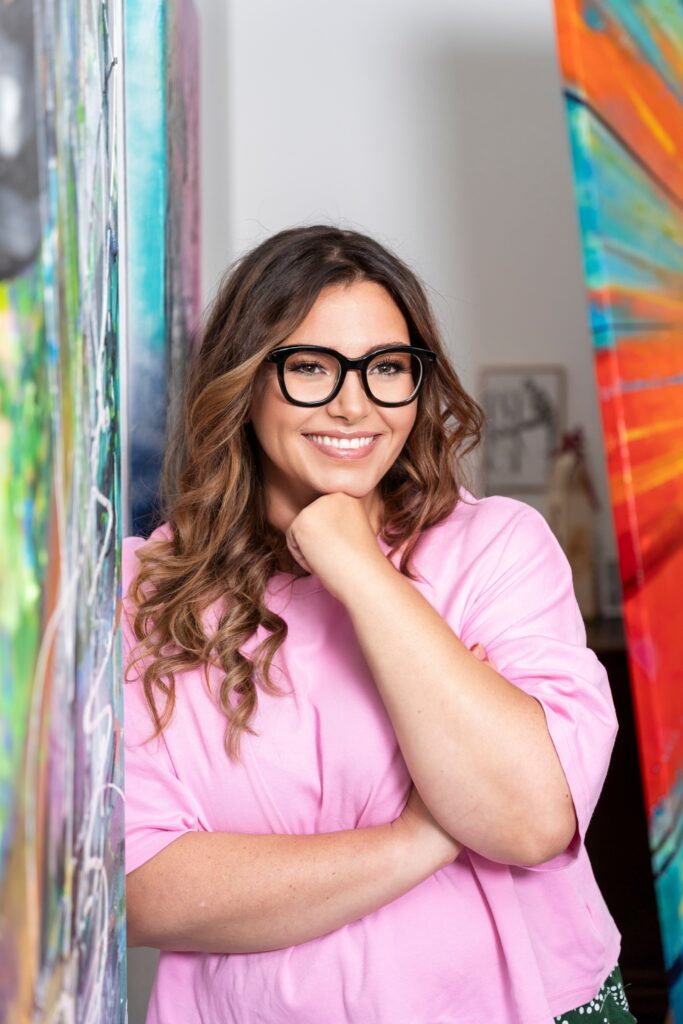
Short Profile
Name: Rike Wölke · contemporary Expressionist artist
Style: contemporary painting, Expressionism, mixed media
Media: acrylic, mixed media
Themes: freedom & letting go · inner worlds & emotions · self-love & personal growth · relationships & interpersonal dynamics · boundaries & transformation · the dialogue between color, form & feeling
Recent: 08/2025 – 11/2025: exhibition “Selbstliebender Mohn” at CCS Galerie Berlin, Berlin. 05/2025: exhibition at Hamburger Kunstgalerie, Hamburg
Instagram: @rikewolke7