The art market is undergoing a profound transformation. Between social media, online platforms and a global art-fair calendar, the classic gallery today looks less like a closed “white cube” and more like a hub in a complex digital network.
At the same time, one central question remains:
What do we still need the gallery for today – and how does it hold its own between direct sales, art fairs and platforms?
This article traces how the role of the gallery is changing and what function a curated online partner like Favori Art can take on in this new landscape.
The Classic Gallery: Three Roles That Remain
Despite all the changes, three tasks of the gallery have proven themselves over decades – and in the digital age they are not obsolete but are being reinterpreted.
1. Curation & discovery
Galleries have always been places of selection:
they discover positions, build programs, set works in relation to one another and give them context. This curatorial work creates orientation – for collectors, companies and institutions.
2. Marketing & development
Galleries accompany careers.
They develop prices, orchestrate exhibitions, make connections, negotiate with collectors and institutions, and make sure a work is not just sold but positioned.
3. Trust & education
A gallery is always a place of knowledge, too.
It translates artistic approaches and explains media, techniques, provenance and editions. This creates trust – the foundation for long-term collections and targeted acquisitions.
These three pillars remain relevant. But the way they are carried out is shifting.
The Digital Shift: Visibility Without Filters – and a New Kind of Overload
The biggest change of recent years is digitalization – and with it, a radical expansion of visibility.
The end of the monopoly on visibility
The gallery used to be the bottleneck: anyone who wanted national or international visibility usually needed a physical gallery. Today, artists can present themselves directly via Instagram, their own websites or marketplaces.
That has advantages – but also side effects:
-
Information overload: there are more images, more profiles and more offers than ever before.
-
Missing context: without a curatorial filter, it becomes harder for collectors and companies to judge quality, stance and long-term relevance.
-
Time pressure: research becomes a full-time job.
The challenge has shifted:
it is no longer about “becoming visible” but about achieving qualified, curated visibility.
How Favori Art curates digital visibility
Favori Art deliberately does not see itself as a mass platform.
Instead of hundreds of random listings, the focus is on:
-
a precise selection of contemporary positions,
-
editorial support (texts, context, curatorial framing),
-
clear positioning of the artists between market, motif and medium.
For collectors and companies, this means:
you are moving within a preselected field, save time on research and can make decisions on a sound curatorial basis.
Art Fairs, Travel, Resources: The Fair as the Epicenter
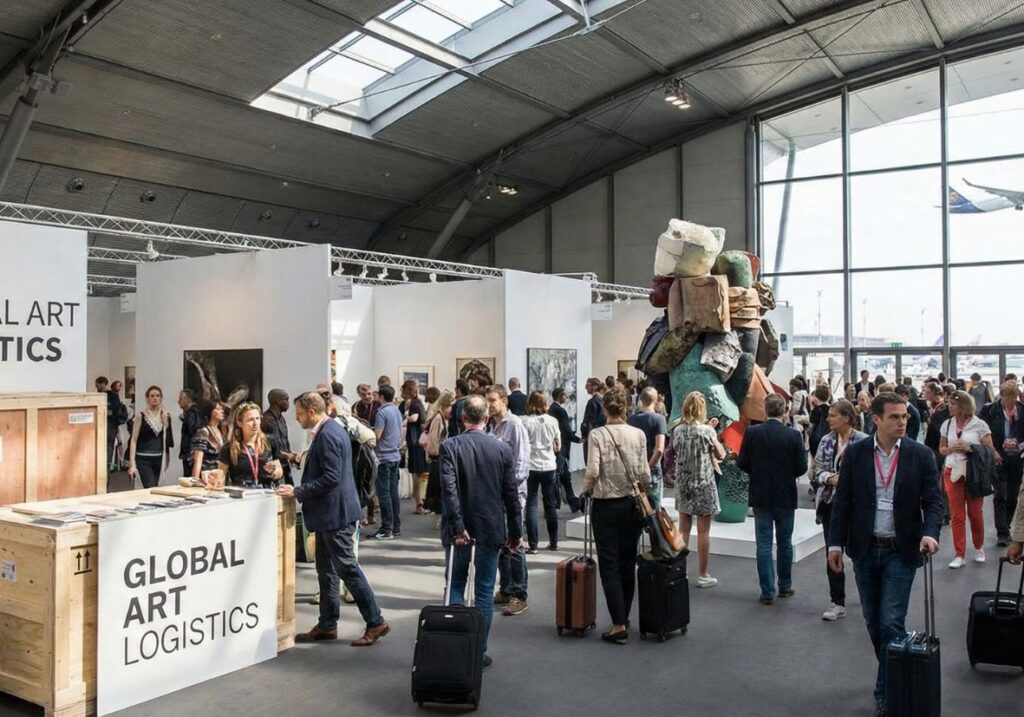
Major art fairs have gained enormous importance; they concentrate attention, contacts and market observation into a few days a year.
For many galleries, however, they are:
-
a heavy financial burden,
-
logistically demanding,
-
usable only for a limited time.
At the same time, collectors and companies today expect permanent visibility and availability – not just during fair weeks.
A digital extension instead of a permanent fair
This is where a new form of collaboration comes in:
Curated online platforms can:
-
extend art-fair presentations,
-
keep positions permanently present,
-
turn contacts made at fairs into long-term dialogues.
Favori Art as a digital extension for galleries and institutions
Favori Art acts as a co-curating partner for galleries, studios and institutions:
-
Works can be placed in curated theme spaces, collector focuses or corporate contexts.
-
Inquiries from collectors and companies are qualified and passed on.
-
Reach becomes global – without a gallery having to be physically present at every fair.
For artists, this means their works are part of a broader yet clearly curated network.
From Sales Floor to Advisory Partner
As the market grows more complex, the role of the gallerist is changing too.
Rather than a mere sales floor, the gallery is increasingly becoming an advisory partner:
-
It supports collectors in building and expanding their collections.
-
It translates trends, positions and price developments.
-
It advises companies on using art in their spaces – from the lobby to the meeting room.
Trust in expertise is central. In digital sales – with distance, screens and shipping logistics – this is all the more true.
Advice, provenance, collector knowledge: how Favori Art builds trust
Favori Art puts this advisory and curatorial expertise at the center:
-
Targeted recommendations and shortlists: instead of endless choice.
-
Private viewings – digital and in person: curated presentations for collectors and companies.
-
Transparent provenance and certification: every work is documented; edition details and certificates of authenticity are part of the process.
-
Collector knowledge, clearly explained: for example in articles and guides – such as on the topic of art in business.
This creates trust – even when the decision is prepared on a screen.
Alliance, Not Competition: Working Together in a Network
The modern art market is a network of artists, galleries, platforms, companies and institutions. Acting in isolation within this structure means giving away potential.
What becomes decisive:
-
transparency in collaboration,
-
clearly defined roles,
-
avoiding duplicate listings and unclear responsibilities.
Favori Art as a connecting, curated hub
Favori Art sees itself as an enabling partner, not as competition to the gallery:
-
Artists receive support with portfolio, positioning and pricing.
-
Galleries receive qualified inquiries and measurable reporting, and stay visible – without giving up control.
-
Companies and collectors benefit from a focused, curated selection tailored to their spaces, brand identities and collecting goals.
The strengths of the classic gallery – curation, personal trust, physical presence – are combined with the possibilities of the digital market: reach, discoverability, transparency.
How Favori Art Works as a Next-Generation Gallery
Today’s gallery is less an exclusive temple than a quality-assured interface:
-
between artists and collectors,
-
between physical space and digital visibility,
-
between the individual work and the long-term collection.
At Favori Art, we translate this stance into concrete work:
-
We curate contemporary painting, works on paper, sculptures and reliefs, and selected editions.
-
Every work receives context: texts, image series, curatorial framing and clear information on technique, format, price range and availability.
-
For galleries, studios and companies, we develop individual presentations – from online viewing to hanging on site.
If you would like to explore what a curated digital presence could look like for your gallery, studio or company, we are glad to support you:
from the first portfolio selection to the development of a clear, long-term art strategy.
This way, digitalization does not become the opposite of the gallery – but its extension.