
Wanting to collect contemporary art is exciting – and sometimes a little intimidating. Price ranges are wide, terms like provenance, editions or certificates sound technical, and in the background there is often the question:
“What if I buy the wrong thing?”
Don’t worry. This guide takes you through the process step by step, so that your first art purchase becomes a good decision – aesthetically, emotionally and, ideally, with solid potential for value as well.

Step 1: Find Your Own Curatorial Voice
The most important advice at the start: buy what you love.
An artwork usually stays with you for years. It should move you, not just “work.” A piece you have no connection to is rarely a good investment – regardless of its possible resale value.
How to sharpen your eye
-
Visit museums, galleries and art fairs, both in person and online.
-
Use curated online platforms like Favori Art to browse with purpose instead of getting lost in the crowd.
-
Notice which motifs, materials, colors or themes keep drawing you in.
If you like a particular artist, take a second look:
-
Research the artist.
-
Look at earlier works.
-
Read the biography, exhibitions and awards.
Consistency, a recognizable signature and a clear artistic stance are good indicators of long-term potential.
Still, stay open: much of the appeal of contemporary art lies in discovering new perspectives – including beyond your own comfort zone.
A tip from Favori Art:
Our curated collections help shorten your research. The works on Favori Art have been selected and contextualized by experts – so you are moving within a preselected field.

Step 2: Budget and Format – How to Get Started Wisely
Before you fall in love, set a budget. There is high-quality art in many price ranges. What matters is that the purchase feels right for you.
A key price factor is the form the work takes.
A. One-of-a-kind originals
Definition:
A unique work, such as a painting on canvas, a sculpture or an individual drawing.
Characteristics:
-
the highest degree of uniqueness
-
often the strongest emotional connection
-
generally higher value potential than series, since the work exists only once
Ideal if your budget allows you to acquire a key work by an artist.
B. Editions and multiples
Definition:
A work that exists in a fixed, limited run – for example a signed photographic print, a screenprint, a lithograph or a sculpture edition.
Characteristics:
-
a much more accessible entry point in terms of price
-
you acquire an original work that is authorized and often hand-signed and numbered
-
a good way to get to know established artists without investing five figures right away
Important:
The number itself (e.g. 3/50 or 47/50) hardly matters in practice. What counts is the total edition size: an edition of 10 is fundamentally more exclusive than one of 500.
But whether original or edition:
the work should always come with a certificate of authenticity – more on that in the next step.
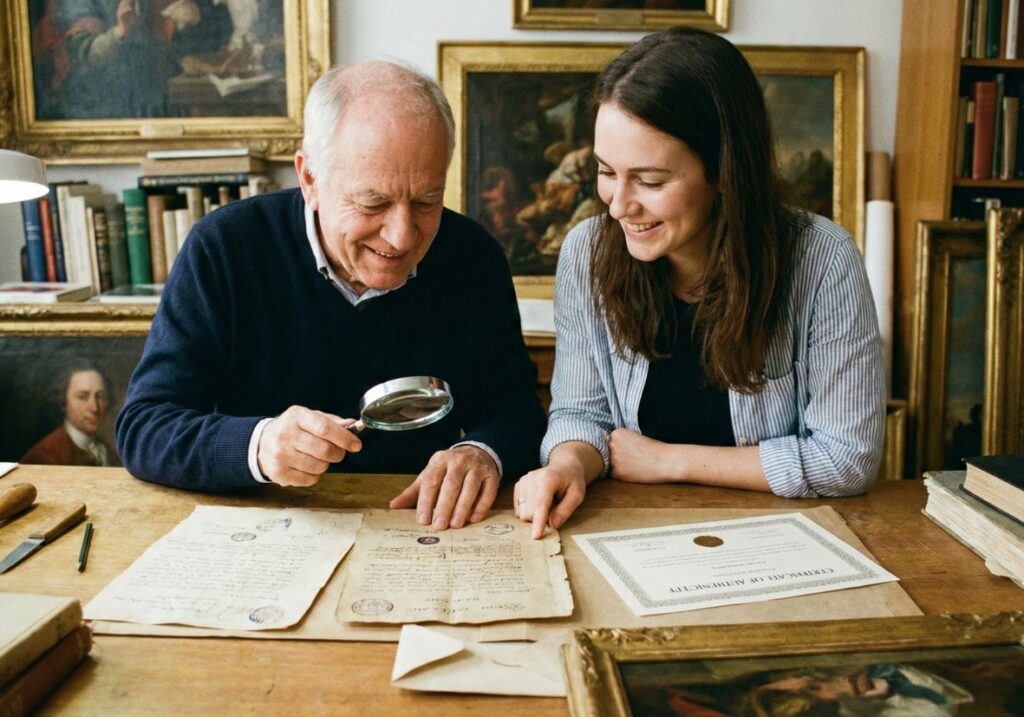
Step 3: Documents That Give You Confidence – Certificate of Authenticity & Provenance
Two terms are central to every serious art purchase: the certificate of authenticity and provenance. They are the written basis for the integrity and value of your work.
1. The certificate of authenticity (CoA)
What it is:
An official document issued by the artist, the gallery or the studio. It confirms that the work is genuine – the artwork’s “passport.”
What it should include:
-
the artist’s name
-
title, year and technique (e.g. “oil on canvas,” “pigment print”)
-
dimensions
-
for editions: edition number and edition size (e.g. 5/20)
-
the signature of the artist or an authorized party
-
the date the certificate was issued
Your role:
Keep the certificate in a safe place. If it is lost, this can significantly reduce the resale value, because authenticity becomes harder to prove.
2. Provenance
What it is:
The documented history of ownership of an artwork – from its creation to its current owner.
Why it matters:
-
It proves legal ownership.
-
It builds trust in the work’s origin.
-
Provenance showing a direct acquisition from the artist or a reputable gallery is ideal.
Your role:
Always ask about existing provenance. Keep the invoice, proof of purchase and correspondence – this documents you as the next link in the chain of ownership.

Step 4: Choose the Right Intermediary
Especially for a first purchase, it makes sense to work with reliable partners who advise you transparently.
The traditional gallery
-
personal support and one-on-one conversations
-
a close connection to the artist’s development
-
help with selection, hanging and sometimes interior concepts
The curated online platform
-
global reach and easy comparison
-
a professional preselection instead of an overwhelming mass of listings
-
high transparency through clear work details, prices and documentation
The Favori Art advantage
Favori Art combines the strengths of both worlds:
-
a curated selection instead of mass listings
-
clear information on technique, edition, certificate and provenance
-
personal advice from experts – online and, where possible, in person
-
support throughout the entire purchase: from the first inquiry to safe delivery
That way, you can be sure you are not just buying a picture but making a well-considered decision.
Extra: Presentation and Care – So Your First Work Feels at Home
Once the artwork has arrived, the best part begins: living with art.
A few things are still worth keeping in mind:
-
Framing: high-quality framing that suits the work protects it and enhances it.
-
Placement: avoid direct sunlight, strong heat sources and high humidity.
-
Insurance: above a certain value, it can make sense to add the work to your homeowner’s or renter’s insurance or to insure it separately.
Your gallery or platform can advise you on this, too – make use of that knowledge.
Your Next Step
You now know the most important basics for your first art purchase:
-
your own curatorial voice,
-
a realistic budget and the right format,
-
confidence through certificates and provenance,
-
and reliable partners at your side.
The most important advice remains:
Trust your feeling – and back it up with good information.
When you are ready to start your collection, we invite you to discover the curated works on Favori Art. Perhaps your first favorite piece is already waiting to be found.
More on First Art Purchase
Find more articles in the Favori Art Magazine and matching works in the Gallery.