A piece about two readings – and about how light becomes a second score.
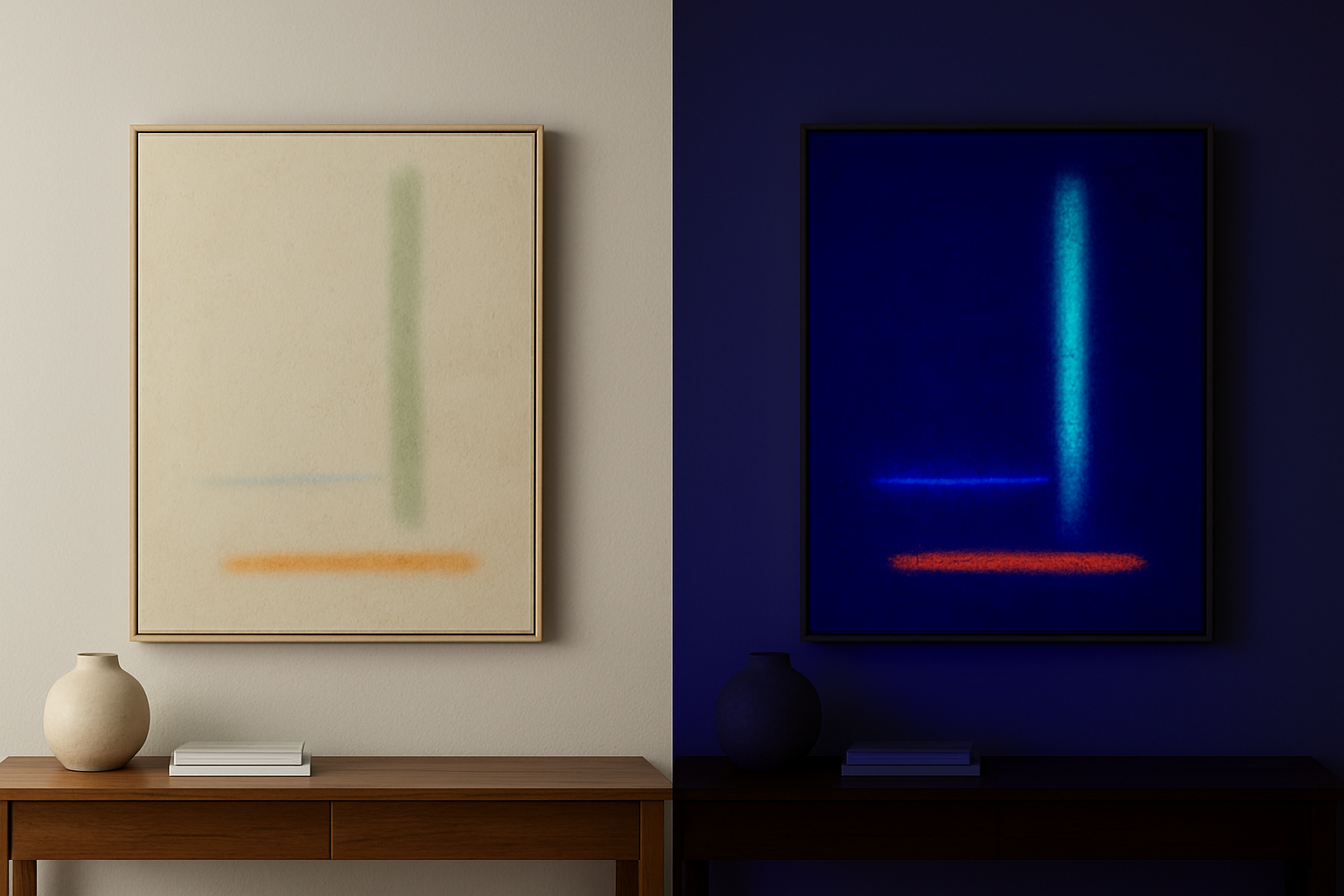
Picture an ordinary evening: you come home, put down your keys, the room is quiet. On the wall hangs a picture you know well – color, texture, form. One click, the UV channel switches on, and suddenly lines appear that were only hinted at during the day. Surfaces begin to glow, as if the work were speaking to you for a moment.
That is exactly what we mean by day–night art: a work that has two legitimate states – day and night. Not a show, not a trick, but a deliberate decision by the artist (and curator) to build in a second reading.
By day, the materiality carries the work; in the evening, UV light shifts the weight, makes accents audible without drowning out the work. Why is this exciting? Because you can experience the same room differently – clear in the morning, contoured in the evening.
Anyone who works with positions in which fine lines and subtle fields of color take on second voices under UV (think of individual works by Matthias Hübner) knows this moment well: the composition stays the same – only the emphasis changes.
Two States – One Stance
Day mode is the fundamental voice: material, traces of process, composition. Night mode is not fireworks but focus. UV-reactive layers respond to invisible light and return it as a fine fluorescence. Good works hold up on their own by day; the night only shifts the weight: an accent becomes clearer, a path through the picture more visible, a quiet veil finds its voice.
Think of the work as a composition in two movements: by day, you set the key. At night, you hear the sound open up – the same score, different dynamics.
With some canvases – those in which delicate structures only reveal their pulse in the evening – you can feel why art does not need “more,” but something different.
We think of spaces first in points of rest, then in rhythm.
Light as Dramaturgy – Not as Show
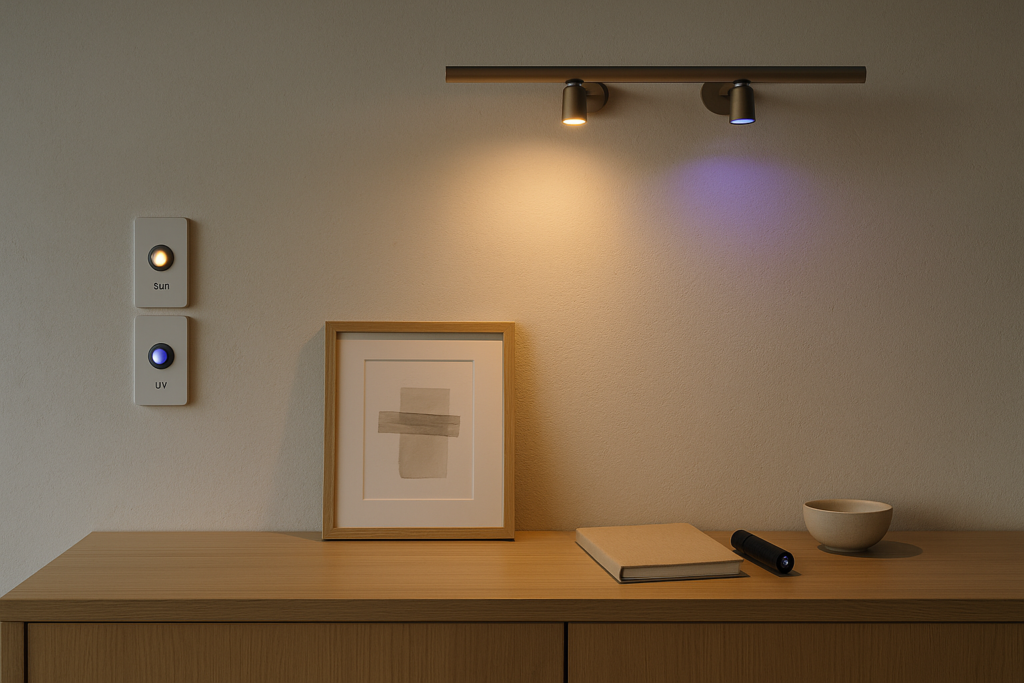
Two separate lighting channels are enough: warm-white light for the daytime impression and a separately switchable UV channel for the night. You don’t use them at the same time but switch deliberately. This moment of switching is not a spectacle; it is a short breath in the room – an invitation to stop and read again. One work, one focus, calm around the picture: that is how precision, rather than effect, emerges.
Curatorial tip: plan the UV moment like a caesura – two to five minutes is often enough. Then the room returns to its basic mood. That way, the night voice stays special.
Anyone who has tried this with a work that deliberately speaks quietly by day (as some of Hübner’s works do) will notice: switching is not an “aha” effect but a breath.
Three Spaces That Play Along
Focus wall (living area):
A day–night piece takes on the role of the lead work. By day it gathers the gaze; in the evening its story condenses into a concentrated sign of light. No permanent UV, but targeted accents that open conversations rather than drown them out.
(Now and then, exactly this kind of focus wall becomes a favorite place – calm by day, with a fine, Hübner-like pulse of lines in the evening.)
Movement zone (stairs/corridor):
Serial works as diptychs or triptychs give the passage a beat. In UV mode, a sense of direction emerges for a moment; in everyday life, the zone remains light, clear and unexcited.
Salon mix (open kitchen/studio):
Combine a day–night work with quiet works on paper. By day, the wall is balanced; at night you set a single word of light. The picture speaks – the room stays yours.
(It works especially well where figuration and abstraction meet – a balance Hübner calibrates finely again and again.)
Quality You Can Feel
How do you recognize good day–night art?
Not “everything glows,” but carefully dosed UV passages: a line, a veil, individual particles that create depth. The work is documented (signature, work details, a certificate noting the UV component) and conceived to archival standards – binders, paper or canvas are carriers of art, not of a show.
Crucially, the work functions without UV. The fluorescent passages feel like deliberately placed nuances – not like “highlights everywhere.” If you are looking for this kind of care, you will find it where there is rhythm in the painting by day – and the night simply lets it breathe a little further.
Quiet Everyday Practice
You don’t need a stage, just clarity. Two separate lighting channels are enough – warm white (approx. 2700–3000 K) and a UV module (typically 365–395 nm), switched separately. Use UV briefly and deliberately, aim the fixture so the picture is evenly lit, and avoid hard shadow edges. In bright areas, anti-reflective glass is worthwhile – test it on the object; in UV mode, less can sometimes be more. It is never about “more light,” but about the right light.
If you love the night voice, plan it like a small scene – not by chance, but composed.
For exhibitions: plan a calm UV island instead of large-scale flooding. The work is a soloist, not a DJ booth.
(In curated presentations – for example when individual paintings are allowed to reveal an extra thread in the evening – this creates the quiet tension familiar from Hübner hangings.)
Communicating Without Words
Show both states – that is enough. One photo in daylight, one in UV mode, ideally from the identical perspective; optionally a five-second clip of the switch. On the label, one sentence is enough: “Second reading in UV mode – accents in line and veil.” That way, even newcomers understand immediately that this is not an effects machine, but art with two voices.
For online & catalogs: work with image pairs (day/night) and a short caption. No effects language, just clarity: technique, year, materials, a note on the UV passages.
Collecting with Purpose
Day–night art suits people who think about their spaces. Clarity in the morning, contour in the evening – two ways of experiencing the same place. You don’t have to choose one reading; you choose a work that carries two stances. That makes it suitable for everyday life and festive at the same time.
Getting started & building on it: many begin with a collector-quality edition that sets precise accents in UV mode, and later add an original as a calm anchor.
What matters is the line: theme, material, key – not the effect.
(Anyone who already lives with Hübner’s works knows this calm consistency: the day holds, the night lifts – and both stay in harmony.)
A Mini Exercise for Tonight
Switch off all regular light and turn on only the UV channel. Take one calm breath. Where does the picture lead you first? Which line calls you? Switch back after two minutes. What remains? That is exactly where the meaning of the second score lies.
In short:
Here, UV light is not a show but a second score. By day, the form stands. At night, the trace speaks.
Which voice would you like to hear today?